Is Life Worth Living? (Ecclesiastes 1:1-3)
Big Idea: True satisfaction and purpose are found only in God, as all other pursuits ultimately prove empty and meaningless.
I'd like you to imagine being given a blank check for anything you want. You are literally told that anything you ask for is yours – whether it be material or otherwise. You want riches? Ask for it. You want a new spouse? It's yours for the asking. You want a long and healthy life? All you have to do is ask. What would you choose?
This question is interesting because of the proliferation of such things as hospital lotteries. You read these brochures and see a brand new gorgeous home with two cars parked outside, and you begin to imagine – what if? At McDonald's, purchasing a McArch Deluxe Meal gives you a voucher for a Lotto 649 ticket. You start to picture donating seven million dollars to the church if you won the lottery. What would you ask for? What would really make you happy?
A man was once asked this question by God himself. This man's name was Solomon, king of Israel after his father King David had died. King Solomon was probably all of 20 years old when he was asked this question:
At Gibeon the Lord appeared to Solomon in a dream by night, and God said, “Ask what I shall give you.” (1 Kings 3:5)
Now talk about a question! What would you ask for? What would make you happy?
Now, I'm sure if I asked you this morning what you would ask for, we would all say wonderfully spiritual things. We might say an end to world hunger, or peace in our times, or the eradication of poverty. But in our heart of hearts, wouldn't we be thinking it would be nice to have a better job, or no job, or a brand spanking new house with two cars?
I occasionally daydream about inheriting a fortune and surprising my family by secretly paying off their mortgages and debts. I imagine them walking into the bank, checkbook in hand, only to hear, "There's nothing due—your balance is zero." That would be amazing.
But consider Solomon's request.
And Solomon said, “You have shown great and steadfast love to your servant David my father, because he walked before you in faithfulness, in righteousness, and in uprightness of heart toward you. And you have kept for him this great and steadfast love and have given him a son to sit on his throne this day. And now, O Lord my God, you have made your servant king in place of David my father, although I am but a little child. I do not know how to go out or come in. And your servant is in the midst of your people whom you have chosen, a great people, too many to be numbered or counted for multitude. Give your servant therefore an understanding mind to govern your people, that I may discern between good and evil, for who is able to govern this your great people?” (1 Kings 3:6-9)
What an answer! Wisdom! The Scripture tells us in 1 Kings 3:10 that God was very pleased with Solomon for asking this. Most kings would have asked for a long life, or wealth, or the death of their enemies. But Solomon asked for wisdom.
Because Solomon asked for wisdom, listen to what God said:
It pleased the Lord that Solomon had asked this. And God said to him, “Because you have asked this, and have not asked for yourself long life or riches or the life of your enemies, but have asked for yourself understanding to discern what is right, behold, I now do according to your word. Behold, I give you a wise and discerning mind, so that none like you has been before you and none like you shall arise after you. I give you also what you have not asked, both riches and honor, so that no other king shall compare with you, all your days. And if you will walk in my ways, keeping my statutes and my commandments, as your father David walked, then I will lengthen your days.” (1 Kings 3:10-14)
He had it made! Wisdom, riches, and honor. Wouldn't you like to be this twenty-year-old king?
Now flash forward. We're nearing the end of Solomon's life. What sort of life do you think he had? Wouldn't you expect it to have been a full life and an enjoyable life? Wouldn't you like to read what Solomon had to say about life?
If I'd been a publisher during Solomon's early reign, I would have immediately secured the rights to his wisdom. People eagerly consume celebrity top-ten lists and fleeting bestsellers. Imagine how they'd treasure the insights of history's wisest king on living well.
You know, there is such a book. The author's name is never mentioned in this book, but descriptions suggest he was likely King Solomon near the end of his life. He was the "son of David" and the "king in Jerusalem." He claimed to have great wealth and wisdom. In all likelihood, Solomon was the writer of this book called Ecclesiastes.
This book was likely written at the end of Solomon's life, capturing his experiences and lessons learned. You see, Solomon had done it all. He began his reign as a humble servant of God, but as he grew older, his heart turned away from the Lord. He dabbled in multiple marriages and false gods. He sought possessions, pleasures, power, and prestige. Here was a man who had tried it all! Here was a man who had gone for the gusto and done everything. In many ways, he was the quintessential man who had arrived. He had done everything. There were no more ladders left to climb. He had arrived.
Now please open your Bibles to Ecclesiastes. We're going to look at just the first two verses today. From now until the end of July, we're going to deal with the bottom-line issues of life.
Ecclesiastes speaks directly to our modern condition, not as some dusty ancient text. Solomon's world mirrors our own with striking clarity, with both societies plagued by poverty, corruption, and failed leadership. Justice systems favor the privileged. Materialism empties hearts. Each generation romanticizes the past.
Solomon's quest for fulfillment mirrors our search. He indulged in pleasures we pursue, accumulated wealth we covet, gained knowledge we chase, and achieved status we desire. Our "if only" fantasies—finding the perfect pleasure, degree, spouse, or career—were Solomon's lived experiments. He was ideally suited to conduct this research, with abundant resources, exceptional knowledge, and the freedom to explore all options for satisfaction.
By the way, the word "Ecclesiastes" means a person who calls an assembly. It refers to someone who organizes a meeting, presents a topic, explores it from various perspectives, and then reaches a practical conclusion. Are you ready for this?
Two Phrases
Let's get our toes wet this morning by looking at his thesis. We're going to wade in deeper next week, but this morning we'll get his main idea for the entire book. It's found at the beginning of Ecclesiastes.
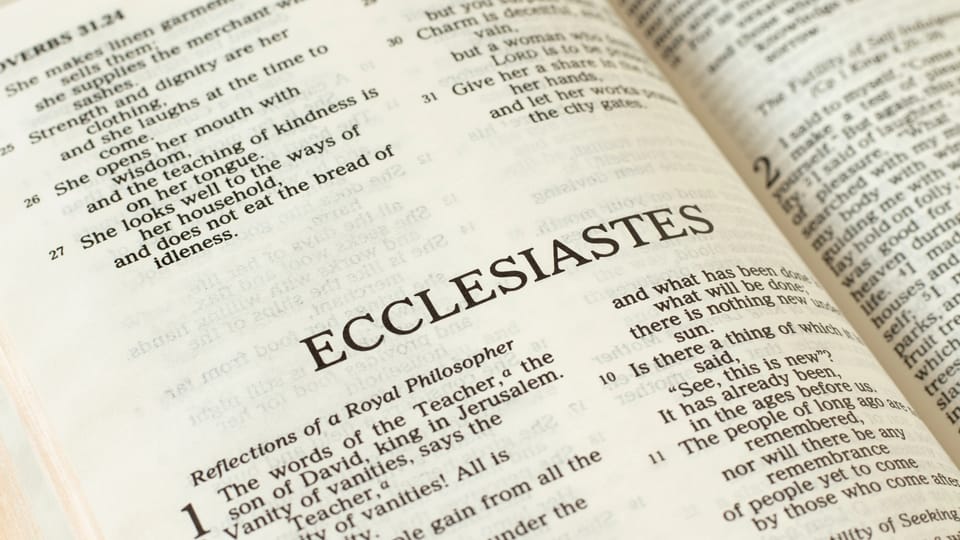
The words of the Preacher, the son of David, king in Jerusalem.
Vanity of vanities, says the Preacher,
vanity of vanities! All is vanity.
What does man gain by all the toil
at which he toils under the sun?
(Ecclesiastes 1:1-3)
Just in case we miss this thesis, he puts it again near the end of his book. "Vanity of vanities, says the Preacher; all is vanity" (Ecclesiastes 12:8).
Let's follow Warren Wiersbe's approach in his introduction to Ecclesiastes and examine each phrase in the thesis.
"Vanity of vanities! All is vanity."
A couple of translations say:
Vanity of vanities, saith the Preacher, vanity of vanities; all is vanity. (KJV)
The Teacher says, "Useless! Useless! Completely useless! Everything is useless." (NCV)
Meaningless. Vanity. Useless. Absurd. These stark verdicts on human existence strike with unusual force. In Hebrew, even a single repetition intensifies meaning significantly—yet here the word echoes five times in one verse. This isn't mere emphasis; it's a thundering pronouncement: all human striving ultimately dissolves into absolute emptiness.
The word in Hebrew literally means "empty; unsatisfactory; futile; absurd." It is similar to vapor, which disappears quickly, leaves nothing behind, and does not satisfy. One professor defined this word as "whatever is left after you break a soap bubble."
What a conclusion for Solomon! The word "meaningless" is repeated over 30 times in Ecclesiastes. Solomon concludes that when he reflects on his wealth, achievements, and wisdom, he realized:
Then I considered all that my hands had done and the toil I had expended in doing it, and behold, all was vanity and a striving after wind, and there was nothing to be gained under the sun. (Ecclesiastes 2:11)
Stephen Covey warns that many climb the ladders of success, only to discover at the top that their ladders were leaning against the wrong walls. In other words, many of us are frantically pursuing the things that Solomon did: careers, success, money, pleasure. But at the end of his life, Solomon could say, "All of this is meaningless!"
I turn thirty this year. According to my pension statement, I will retire on August 1, 2032. That means that if God spares me, I have thirty-five more years of ministry left in me. And hopefully a few years after that to spend as Bill does – basically retired, a "man of leisure."
It's beneficial for someone young like me to realize that many things I might want to pursue are actually meaningless and unfulfilling. Some of you are younger than me; some of you are quite a bit older. Listen to Solomon's wisdom; he experienced these things and realized they don't provide the lasting satisfaction they claim.
One man described life as a "blister on top of a tumor, and a boil on top of that." Solomon would ultimately agree with that assessment. With one caveat to this, and we're about to find out what it is.
"Under the sun"
What does man gain by all the toil
at which he toils under the sun?
(Ecclesiastes 1:3)
Solomon defines his terms of reference: he is looking at life "under the sun." This phrase occurs twenty-nine times in Ecclesiastes, along with the phrase "under heaven." Basically, Solomon is looking at life from a human perspective, not from heaven's point of view. He is looking at life only from a human perspective. We have to remember, as we read Ecclesiastes, that most of the time he is reflecting life apart from God.
G. Campbell Morgan writes:
This man had been living through all these experiences under the sun, concerned with nothing above the sun… until there came a moment in which he had seen the whole of life. And there was something over the sun. It is only as man takes account of that which is over the sun as well as that which is under the sun that things under the sun are seen in their true light.
Now I'll give you a hint as to one of the applications of this book. Life only makes sense with God. A few years ago there was this slogan that Coca Cola used, "Things go better with Coke." Let me rephrase this statement to reflect one of the truths of Ecclesiastes: "Life goes better with God." In fact, life only makes sense with God. Apart from God, from an "under the sun" perspective, life is utterly futile, empty, and meaningless. We need God and a personal relationship with his Son in order for life to make any sense.
Let's get real: a lot of people, including you and me, are on the search for a life filled with satisfaction and purpose. We tend to look in all the wrong places. I guarantee there are people in your office and neighborhoods who are looking for God and don't know it. They are sensing that their lives are empty and futile and meaningless, and they are searching for something to fill that void. They are looking for pleasure or achievement to fill this void, but the message of Ecclesiastes is that only God can fill this void.
A lot of people are looking for God and don't even know it. In the end, friends, only God can truly bring satisfaction and purpose in life.
Psalms 37:4 says:
Delight yourself in the LORD,
and he will give you the desires of your heart.
We find true and lasting satisfaction by delighting in God. A pleasure that satisfies more deeply than anyone or anything else ever could. A pleasure and satisfaction that cannot be taken away.
These are the two phrases that set the tone of this book. This is the thesis of the book of Ecclesiastes: life apart from God is futile, empty, and unsatisfactory. Only God can satisfy the deep desires of the heart. All else is meaningless.
Three Assignments
We're going to dive headfirst into Ecclesiastes next week, but for this morning I want to give you three assignments:
First, open your life to the gospel. Take this opportunity to examine your heart and life in light of God’s truth. Ecclesiastes challenges you to face life's emptiness without God and directs you to the good news of Jesus Christ, who provides true meaning and satisfaction. Submit yourself to this message, allowing the gospel to reveal where you’ve been seeking fulfillment in the wrong places.
Second, invite a friend to hear the gospel. Augustine said we all have a God-shaped vacuum in our lives. Your friends who don’t know Christ are searching for something to fill that void, even if they don’t realize it. Ecclesiastes is the perfect book to show them the futility of life without God and the hope found in Jesus. Think of creative ways to invite them to join you or to share the gospel truths we’ll uncover together.
Third, delight in God through the gospel. Life apart from God is meaningless, but through Jesus, we find forgiveness, purpose, and joy. Only the gospel can satisfy the deepest desires of your heart. Make it your aim to treasure Christ above all else, finding your ultimate delight in him. True satisfaction comes when we rest in the finished work of Jesus and live for his glory.