When Love Has Limits (Luke 10:25-37)
Big Idea: Loving God means that we cannot place limits on whom one must love as a neighbor.
I know you’re a deeply loving person. I see it week after week in the way you treat others. So here’s what I want to ask: is there anyone you feel is not worth your love?
We don't announce it, but we carry around an internal calculus, a sense of who's worth the effort, who deserves our sympathy, who has earned care. And somewhere in that calculus, there are people we've quietly written off:
- The one whose politics feels like a threat to everything you cherish
- The person who always seems to be in mid-crisis, so that every interaction feels like it’s slowly draining you
- The addict who’s burned every bridge and is living on his third “last chance.”
- The public moral failure whose repentance feels suspiciously timed
- The coworker who’s difficult in ways that feel almost intentional
- The person whose theology is “off” enough that you’ve gently demoted them in your heart
- The family member who took and took and never gave back
None of us would stand in a church service and announce, “Those people don’t deserve love.” But we’ve learned to keep our distance, to set boundaries. We’re loving people, but deep down, we know that our love has limits.
And that’s where the parable this morning presses in and challenges all of us.
Two Questions
Question One
The parable arises from an interaction Jesus had with a lawyer, a term that Luke used to describe the scribes in Jesus’ day. This was a highly trained Torah scholar, an “expert in the law,” who studied, interpreted, and applied Scripture and its received traditions to everyday life. He functioned like a blend of theologian and legal expert, skilled at defining terms and setting the boundaries of obligation.
And here was his question: “Teacher, what shall I do to inherit eternal life?”
He showed proper respect. Back then, teachers sat, and students stood out of courtesy. But Luke identifies that his intentions weren’t sincere. The lawyer asked this question to test Jesus. The lawyer believes he’s part of the in-crowd, and he wants to know how to stay there.
Jesus responds with his own question. He asks the man, “What is written in the Law? How do you read it?” Two questions: content and interpretation. The content is clear. He quotes the Shema from Deuteronomy 6:4:
And he answered, “You shall love the Lord your God with all your heart and with all your soul and with all your strength and with all your mind, and your neighbor as yourself.” (Luke 10:27)
Shema is simply the first word of the passage. In Hebrew it means “hear” or “listen”: “Hear, O Israel: the LORD our God, the LORD is one.” It became the daily rhythm of Jewish faith—recited morning and evening. Children learned it first; adults bound it to their bodies in phylacteries and fixed it to their doorframes.
So when Jesus asks about the greatest commandment, the expert answers with the words he has prayed his whole life: love God. Then he adds Leviticus 19:18: love your neighbor. He doesn’t need more information; he already knows the right words by heart. Everyone did. The youngest scholar in the synagogue knew the answer.
So Jesus replies, “You have answered correctly; do this, and you will live” (10:28). He’s right. The standard is clear: love God fully, love your neighbor truly, and you will live.
The problem, of course, is that none of us has ever kept those two commands with an undivided heart. We have not loved God with everything we are, and we have not loved our neighbor with a steady, selfless, wholehearted love. We have not done what God requires.
He has the right answer, but he hasn’t faced his real problem. What he should have said is, “Lord, have mercy on me. I know your law, but I can’t keep it. I don’t love God the way I should, and I don’t love my neighbor the way I love myself. Tell me how a sinner like me can be saved.”
Instead, he asks a second question.
Question Two
Here’s what the scribe asked as his second question: “And who is my neighbor?” (10:29). In other words, “Okay, I’m called to love my neighbor. How can I tell who is my neighbor and who isn’t? How can I spot the people I’m supposed to love?”
It seems many in that period treated “neighbor” as a fellow Israelite, someone inside the covenant community. In practice, that often pushed Samaritans, foreigners, apostates, and resident outsiders to the margins, as though they fell beyond the reach of the command to love. The circle had clear boundaries: some were “in,” and many others were “out.” After all, we reason, you can’t help everyone, so you draw the line somewhere.
We ask the same question today. We know we should love the people closest to us, but we quickly start managing love by narrowing it. We keep our distance from the inconvenient, the complicated, the different, or the ones who have hurt us. We rarely say, “Who is my neighbor?” out loud, but we ask it with our calendars, our attention, and the quiet lines we draw around our mercy.
And that’s where Jesus’ parable comes in.
The Compassionate Samaritan
Scene
The scene is the steep road from Jerusalem to Jericho, a long descent into the desert, a trip that weighed on your legs and was not taken lightly. It winds through the harsh Judean wilderness: sun-baked limestone, narrow ravines, blind turns, and caves in the cliffs, with little shade and long stretches of isolation. The trip typically took five to seven hours on foot, so it wasn’t casual. It was also infamous for robbery, so well known that Jesus’ listeners would have felt the danger the moment he named the road.
Characters
Then you have the characters.
You have the victim, a man who is robbed. He’s stripped, beaten, and left for dead.
Then you have a priest and a Levite. Many priests and Levites actually lived in Jericho. It was a prosperous city, comfortable for families. They commuted to Jerusalem for their Temple rotations. So the priest and the Levite in Jesus' story are not random passersby. They are men who walked this road regularly. They would know exactly what it looked like when something had gone wrong on it.
Then you have a Samaritan. The Samaritan would be the person in the story who got booed as he was introduced. The hostility between Jews and Samaritans ran for centuries: deeply theological, deeply personal, and felt on both sides. Samaritans were a mixed population that Jewish people in the south never fully accepted as legitimate heirs of the covenant. Traditions warned against Samaritan food and contact, and many travelers took longer routes to avoid Samaritan territory altogether. “Samaritan” could function as a slur.
You have a victim, two good guys, and someone you would hate just because of who he is.
The Tension
Who would you expect to be the good guy in the story?
In Jesus’ story, the first response comes from the top of the hierarchy. The priest walks by. He is a decent, religious man who has just finished serving God in the Temple. He sees the victim, and he keeps walking. We don’t know why. Maybe he feared becoming ritually unclean from touching someone who may be dead. Maybe he was cautious; the same robbers could have pounced on him too.
Then you go down a little in the hierarchy. A Levite walks by. A Levite was part of the Temple workforce. Levites played supporting roles. They were essential but not quite at the top. He acts the same way the priest did, probably for the same reasons. He stays as far away as possible and avoids any contact.
Then you go way down the hierarchy. You would expect the next step down to be an ordinary Jewish layman: priest, Levite, ordinary Israelite. That's how the structure worked. The punch line was supposed to redeem the common person against the religious professionals.
Jesus doesn’t take the next obvious option. He goes as low as the story can go, to the least expected neighbor: a Samaritan. In Jesus’ world, he’s the disqualified one: outsider, unclean, unwelcome. And yet he stops and shows compassion to the very kind of man he would’ve been expected to avoid—a wounded Jewish stranger.
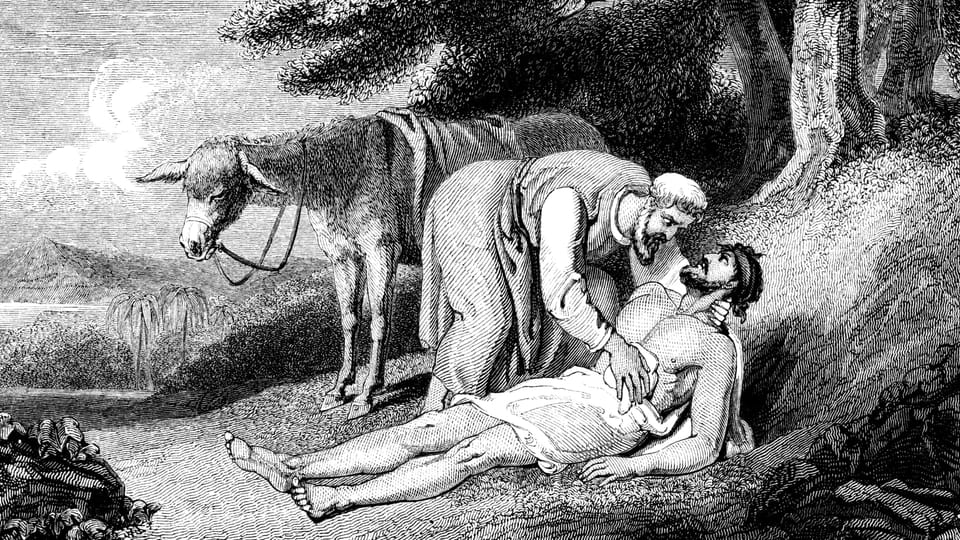
The Samaritan’s actions are costly. He cleans and wraps the wounds. He puts oil and wine from his supplies on them. He lifts the man onto his own animal, likely getting blood on himself, and walks the road with him. He brings him to an inn, stays the night to care for him personally, and when he leaves he pays the innkeeper two days’ wages to cover the man’s needs. Then he adds the line that makes the generosity unmistakable: “Whatever more you spend, I will repay you when I come back.” He doesn’t just help in the moment; he takes responsibility for the outcome.
He stops on the most dangerous road in the region. He gives of his own provisions. He gives up his ride and protection. He spends them freely on someone who can’t repay him. He commits to future costs he cannot calculate. He crosses every boundary with no promise of a good outcome. It’s completely unexpected, and it’s shocking even today.
Jesus hasn't just answered his question. He’s done even more. He's taken everything the lawyer used to organize his moral world — insider and outsider, clean and unclean, worthy and unworthy — and turned it over completely.
Jesus asks, “Which of these three, do you think, proved to be a neighbor to the man who fell among the robbers?”
Notice what he does. The lawyer asks, “Who is my neighbor?” Jesus flips it: the real question becomes, “Will I receive help, even from someone I’ve labeled unclean, wrong, or enemy?” The story doesn’t just expand the definition of “neighbor.” It turns everything upside down.
Notice what Jesus does here. The man sees himself as someone ready to help others. Jesus recasts him as the one who needs help. He flips everything upside down. Instead of being the hero, he asks the man to consider being in need.
And this is actually a closer picture of what we're like. We think we're so ready to help others, but the reality is all of us are going to need help ourselves.
What if you were bleeding out on the road, helpless and running out of time, with only hope for mercy from someone who owes you nothing? Would you want grace then?
The man can’t even bring himself to say, “The Samaritan.” Instead he says, “The one who showed him mercy.” Jesus responds by saying, “You go, and do likewise.”
In other words, we may even need to receive a lesson from someone we’d rather avoid. Instead of spending our energy trying to craft a tighter definition of “neighbor,” we need to get moving and love the people God has placed right in front of us. You can’t define your neighbor; you can only be a neighbor.
Whenever someone in real need crosses our path, we should respond with compassion and help as we would hope to be helped, even if that person isn't someone we would typically choose to love.
As one Methodist commentator (Joseph Benson) said two hundred years ago:
Show mercy and kindness to everyone that stands in need of your assistance, whether he be an Israelite, a heathen, or a Samaritan, and when works of charity are to be performed, reckon every man your neighbor, not inquiring what he believes but what he suffers… Let us attend to and diligently put in practice our Lord’s advice to this lawyer; let us go and do likewise, regarding every man as our neighbor who needs our assistance.
Loving God means that we cannot place limits on whom one must love as a neighbor.
After all, this is how Jesus loved us. When Jesus came to our aid, we weren’t dying; we were dead. Jesus didn’t just cross the road to help us; he left heaven for us. It took him more than a day or two and a few day’s salary to gain our salvation. It cost him his life.
Jesus traveled a much greater distance, to help people in much greater need, at much greater cost. He is equally committed to seeing our salvation through to the end, for he has promised to come back and carry us all the way to glory. (Phil Ryken)
Now this Good Neighbor says, “You go, and do likewise” (Luke 10:37). Be a good Samaritan to the people you meet along life’s way. Who is the person that needs your help that you’d rather ignore?
Don’t excuse yourself. Don’t look away. Don’t keep your distance. Stop. Draw near. Help. And don’t step in only to step out again. By God’s grace, stay with it and follow through until the work is finished.
And don’t do any of this to earn eternal life, but because eternal life has already been given to you. When you were beaten, bloodied, and left for dead, Jesus came to you and showed you mercy.