Rich in the Wrong Things (Luke 16:19-31)

Big Idea: Earthly comfort without Christ is spiritual bankruptcy.
I have a problem, and I’m guessing you do too. I really like nice things.
A couple of times, we’ve been able to stay at really nice hotels. I’m talking about five-star hotels. I love the feeling of luxury, of the extra service, the custom finishes, the feeling that you’re experiencing something above how you normally live. When I stay in a rundown hotel, I have to work to adjust. But when I stay in a luxury hotel, I spend zero time adjusting. It all comes so naturally to me.
A few weeks ago, we were driving home from church. I noticed the car in front of me is a Maybach. I’d never heard of that before, so I looked it up. Maybach is a German luxury car brand owned by Mercedes-Benz. That car we saw probably sold for a quarter of a million dollars. I looked it up. Apparently you feel like a celebrity — like entering a private lounge that happens to move. Again, I don’t think it would take much to get used to driving one of these vehicles.
I have a problem: I really like nice things. I can’t afford them, but I like them. So what’s the problem with that? The story we just read provides the answer, and I think it’s going to challenge every single person in this room.
Two Characters
In Luke 16:19 to 21, we’re introduced to two characters.
First, we’re introduced to a rich man. Verse 19 says, “There was a rich man who was clothed in purple and fine linen and who feasted sumptuously every day.” We learn three things about this man:
- He was rich. He had lots of money.
- He could afford the best clothes. Jesus mentions two pieces of clothing. The first is purple. Purple was extremely expensive and functioned as a marker of elite status. The dye came from a tiny mollusk found along the Phoenician coast, and extracting it required such intensive labor that only royalty and the wealthy could afford garments dyed in this color. The choice to wear purple wasn’t incidental; it was a deliberate public declaration of his wealth and social position. Underneath, he wore fine linen, the most expensive imported Egyptian underwear, the most delicate and most expensive fabric known to the ancient world. Even his undergarments were marked by comfort, softness, and expense.
- We also learn about this diet. He “feasted sumptuously every day.” Most people in his world lived on simple staples: bread, soup, maybe fruit. A feast was the kind of thing you expected at a wedding or a once-in-a-while celebration. But for this man, celebration wasn’t occasional; it was routine. He ate like a connoisseur, enjoying the finest food not as a rare treat, but as his everyday normal.
He had everything we tend to want: security, comfort, freedom, and prestige. That’s the first character. Then we’re introduced to the second.
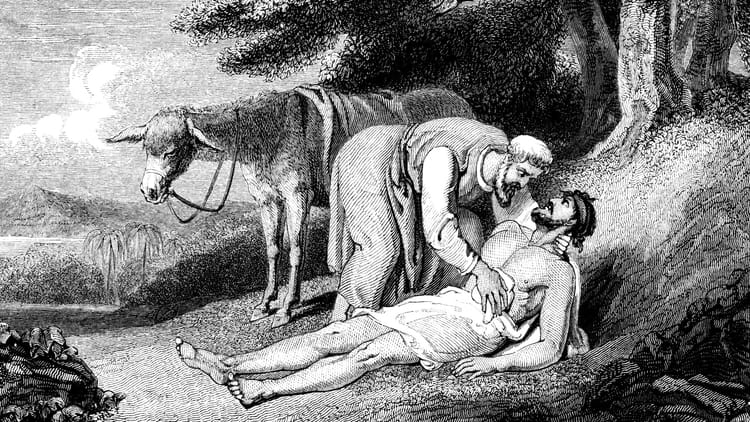
And at his gate was laid a poor man named Lazarus, covered with sores, who desired to be fed with what fell from the rich man’s table. Moreover, even the dogs came and licked his sores. (Luke 16:20-21)
The first character is nameless in Jesus’ story, but this character has a name: Lazarus. And he couldn’t be more different.
- He’s poor, not rich.
- He was laid there, implying that he’s unable to move himself. It’s possible that friends laid him there, expecting he could get some help from the rich man.
- He’s covered in sores, and he has dogs licking those sores. In Palestinian Jewish culture, dogs were seen as dirty scavengers, like rats. Their tongues would have hurt his sores, so their presence was more of a pain than a comfort. It would have also made him ceremoniously unclean.
- He’s hungry. The rich man enjoys the best of food; this poor man longs to be a scavenger enjoying the rich man’s garbage once the feast is over.
One man has everything. The other man has nothing. Who would you rather be? I don’t think there’s a doubt. Given the choice between an affluent life and abject poverty, I don’t think there’s a person here who would choose to be like Lazarus.
The Extended Timeline
But what if you extend the timeline? That’s what Jesus does in verses 22 to 31.
The poor man dies. There’s no mention of a funeral or a burial. He was destined for a pauper’s grave at best. But in verse 22, we read that angels carry him to Abraham’s side. This is a complete vindication and reversal of Lazarus’s earthly status. Though he was invisible and abandoned in life, divine beings attend to him in death, affirming that God witnessed his suffering and honors his faithfulness. He is welcomed into fellowship with Abraham himself.
The phrase “Abraham’s side” carries particular cultural weight. In a banquet setting, the most honored seat was nearest the host, reclining so closely that one’s head could rest near his bosom. Lazarus, then, occupies the place of highest honor and intimacy.
He goes from poor to rich, from unknown to recognized, from excluded to included. It’s a complete reversal.
What’s just as shocking is what happens to the rich man. Verse 22 says he dies and is buried. We can assume he had a lavish funeral appropriate for a man of his social class. As a rich man, he may have been buried in an elaborate tomb. But then everything changes.
He enters Hades. In Jewish understanding, this is where the spirits of the dead went to reside. But it is not a nice place. He’s tormented. The rich man experiences torment with flames and unquenchable thirst. He is suffering, very thirsty, and "in agony in these flames." He can see Abraham from where he is buried, which adds to his pain. He knows what he has lost but cannot reach it. Not only is he suffering in hell, he can see heaven, and he can see Lazarus there.
This is a complete reversal. The point is clear: a beggar—once sick and hungry, with no earthly pretensions—becomes rich in eternity. Lazarus is known by name. He is helped and comforted. The rich man—once healthy, wealthy, and enjoying the finest things in life—now suffers the worst torment in death, his last requests denied.
Now who would you rather be? Jesus is making a point. If you take the short view, a luxurious life of comfort looks really good. But if you take the longer view, being rich isn’t about earthly comfort. It’s about having what matters eternally, and can’t be taken away. Eternal rewards far outweigh earthly luxuries.
Every Request Denied
What really lands in this story is the finality of the rich man’s spiritual poverty. He makes two requests, and both of them are denied.
The First Request
Request one in verse 24: “Father Abraham, have mercy on me, and send Lazarus to dip the end of his finger in water and cool my tongue, for I am in anguish in this flame.”
He still thinks that his former position counts for something. He still makes requests like he’s in charge. He was so used to power in his old life and the clout his money gave him that he acts as if things are unchanged even in Hades. He does not repent and thinks that he can order Abraham to send Lazarus to be his lackey. This detail reveals that he recognized Lazarus and knew his name! He could not have been unaware that Lazarus was lying at his gate. Though he never spared a thought for Lazarus’s needs during his lifetime, the rich man, self-centered even in death, thinks he should minister to his suffering now. He asks Abraham to send the poor man on an errand, like he still has the power to call the shots and to boss people around. But none of that works anymore. His worldly advantages don’t count for anything in eternity.
The reply comes:
Child, remember that you in your lifetime received your good things, and Lazarus in like manner bad things; but now he is comforted here, and you are in anguish. And besides all this, between us and you a great chasm has been fixed, in order that those who would pass from here to you may not be able, and none may cross from there to us. (16:25-26)
We learn a couple of important things here, things of eternal importance.
First, God’s kingdom involves profound reversal. In this life, the man had a lot of money, and that isn’t the problem by itself. The problem is what he did with it. His spending revealed his heart: he used his wealth for himself instead of letting it become a means of loving God and loving others, and that had eternal consequences. Few things reveal our spiritual condition like how we use our money.
He was rich, but when you strip the money away, there’s nothing left. He is exposed as financially wealthy but spiritually bankrupt, and that bankruptcy cost him everything. He wasn’t prepared for eternity.
It’s as if Abraham is saying, “My son, you had your good things. But your good things were temporary. Now they’re gone, because in eternity I am the only good thing that lasts forever. And now you’re left hollow, gnawing in the dark, drowning in self-pity, filled with emptiness. That emptiness begins even now. It’s the beginning of hell.”
Friends, our deepest poverty is met in Christ, and our truest riches are found in him. When Jesus is our main thing, not just someone who helps with our good things, we can let go of our comfort, face suffering without losing hope, and use what we have for lasting purposes. If you have Jesus, you have everything, even if you have nothing. If you have everything but don’t have Jesus, you have nothing.
There’s also a sobering truth here: our eternal destiny is final. The chasm is not temporary or negotiable—it is fixed by God and cannot be crossed in either direction. No one from the place of comfort can come to help, and no one in torment can escape.
That finality is underscored by the rich man’s unanswered requests. He asks for relief, then for a warning to be sent to his brothers, but both pleas are denied. The chasm doesn’t just separate locations; it seals outcomes. Choices made in this life carry consequences that death does not undo.
Verse 26 presses the point home: eternity is not a second chance, but the confirmation of what we have chosen in time.
God’s kingdom brings a great reversal: many who are rich in this world will be exposed as spiritually poor, while those who seem poor now may prove eternally rich. Christ alone is lasting treasure. And when death comes, our destiny is fixed—there’s no second chance to rewrite what we chose in this life.
The Second Request
But then there’s the second request in verses 27 and 28: “Then I beg you, father, to send him to my father’s house— for I have five brothers—so that he may warn them, lest they also come into this place of torment.”
Abraham replies that Moses and the prophets are enough.
But the rich man keeps arguing in verse 30. “No, father Abraham, but if someone goes to them from the dead, they will repent.” Again, the response: “If they do not hear Moses and the Prophets, neither will they be convinced if someone should rise from the dead.”
This teaches us something crucial: Scripture is sufficient. The rich man thinks that a miracle would work better than words from the Bible, but Abraham's answer shows the opposite. People who ignore the clear message of the Bible won't be swayed by amazing signs, no matter how fantastic they are. The problem isn’t a lack of evidence; it’s a hardened heart that won’t yield to what God has already spoken. The barrier to salvation is not the absence of proof, but the refusal to respond to the truth already given.
What’s the Point?
So what’s the point of this parable? It’s not that wealth is automatically sinful. The point is this: earthly comfort without Christ is spiritual bankruptcy, and many people won’t realize it until it’s too late. That’s why the time to respond isn’t someday. It’s now.
If we’re honest, we all feel the pull of comfort. We like security. We like options. We like having enough—and then a little more. But the more we build our lives around what we have and what we want, the more exposed we become to real danger. We can possess every earthly advantage and still be spiritually empty. Yet if we have Jesus, we are not lacking; we are truly rich.
Our deepest poverty is met in Christ, and our truest riches are found in him. Through the gospel, Jesus has given us something that is more valuable than anything else and that can never be taken away. Jesus isn’t simply a way to upgrade our lives; he is the treasure. He is the only “good thing” that lasts forever. The rich man spent his days gathering comforts that couldn’t follow him past the grave. But Christ gives what death can't take, what pain can't steal, and what time can't wear away: lasting joy, safe security, and a kingdom that won't fall.
So the invitation today is both simple and urgent: don’t waste your life chasing temporary “good things.” Come to Jesus. If you have much, hold it loosely and steward it gladly for eternal purposes. If you have little, don’t despair—because in Christ you can be truly rich. And don’t measure your life by what you can enjoy right now, but by who you belong to forever.