God’s Help for our Deepest Problem (Isaiah 9:1-7)
Big Idea: God responds to our deepest need by sending a royal King to deliver us.
Two months ago, a tropical wave originated in west Africa and moved to the Caribbean Sea. As it moved to the central Caribbean, it slowed down and became Tropical Storm Melissa. For days it moved slowly and erratically. It didn’t really go anywhere. Gradually, though, it became a Category 5 hurricane before making landfall in Jamaica at its peak intensity on October 28. It was the most intense hurricane at landfall in the Atlantic basin. It caused torrential rains, landslides, and widespread flooding. It caused loss of life, severe destruction of homes and infrastructure, massive power and water outages, and deep economic damage, especially in coastal and farming communities.
But I want you to think of those days when the storm was strengthening. They knew the storm was coming and there was little they could do. As Melissa strengthened into a Category 5 and turned toward Jamaica, Prime Minister Andrew Holness said publicly, “I have been on my knees in prayer.” He knew a tragedy was coming, and that the island that simply did not have infrastructure built for that level of force.
A hotel owner fled to Kingston as he watched the sea and read the latest forecasts. He said:
Jamaicans are very deep in their faith… we tend to think that we can pray something away. And for the most part, we have been spared… At some point, the luck is going to run out, the blessings are going to run out. And I hope and pray this is not that day. But it is looking like it is that day.
What do you do when you know disaster is coming, and you can’t do anything about it? That is the problem people in Jamaica faced a couple of months ago, and it’s the problem people in Isaiah’s day faced too.
Disaster Coming
The date was some 2,700 years ago. King Ahaz was on the throne in Jerusalem reigning over Judah. But a storm was brewing. A new superpower called Assyria was on the move, and it was expanding westward with ruthless efficiency.
People were terrified. They would have heard the stories: whole cities in the north flattened; fields torched, orchards cut down; people impaled on stakes outside captured towns; leaders flayed or beheaded; survivors led away in chains with hooks through their lips or noses. They had already seen what Assyria could do in the northern regions of Israel, devastating the area and deporting its people. Now they knew they were next. And they knew what it meant. It was only a matter of time before they saw well-armed infantry, archers with composite bows, shield-bearers, heavy spearmen; chariots plus masses of soldiers from conquered nations. Even worse, siege equipment: battering rams on wheels with protective coverings, siege towers, ramps being built near your walls.
In Isaiah 8, the prophet Isaiah prophesied that Assyria was coming, and compared Assyria to waters that would “sweep on into Judah, it will overflow and pass on, reaching even to the neck, and its outspread wings will fill the breadth of your land” (Isaiah 8:8). It was going to be bad. And the reason wasn’t just because Assyria was on the rise. The reason was because Judah had rebelled against God. They were in a desperate situation: under a covenant curse, sitting in a deep gloom of their own making, and facing a foreign threat that was going to devastate them.
What would you do? You would probably do what Judah and King Ahaz did back then. You would have tried to come up with your own solution. 2 Kings 16:8 records what Ahaz did: “Ahaz also took the silver and gold that was found in the house of the LORD and in the treasures of the king’s house and sent a present to the king of Assyria.” Ahaz stripped the temple and tried to bribe the king of Assyria, but it changed nothing. They continued their sinful ways. They rejected God’s word. They continued to seek help from mediums and necromancers. Assyria was still coming, and Ahaz could do nothing about it. For a moment, think about what it would have meant to hear Isaiah say these words: “And they will look to the earth, but behold, distress and darkness, the gloom of anguish. And they will be thrust into thick darkness” (Isaiah 8:22).
Judah was about to face distress, hunger, rage, and spiritual darkness. It was a desperate situation with very little reason for hope.
Earlier I asked a question: What do you do when you know disaster is coming, and you can’t do anything about it? Let me add to that question. What do you do when you know disaster is coming, and you can’t do anything about it, and your attempted solutions make things even worse?
That is the problem that Isaiah 9 is designed to address.
God’s Solution to our Greatest Problem
Read 8:22 along with the first verse of chapter 9:
And they will look to the earth, but behold, distress and darkness, the gloom of anguish. And they will be thrust into thick darkness. But there will be no gloom for her who was in anguish.
In a moment, everything changes from distress and thick darkness to no gloom or anguish. What changed? In chapter 9, God intervenes. God responds to our need by doing what we couldn’t do in solving our greatest problem.
Help comes where we need it most (9:2)
But there will be no gloom for her who was in anguish. In the former time he brought into contempt the land of Zebulun and the land of Naphtali, but in the latter time he has made glorious the way of the sea, the land beyond the Jordan, Galilee of the nations.
The people who walked in darkness
have seen a great light;
those who dwelt in a land of deep darkness,
on them has light shone.
I want you to notice where the light will come. The northern tribes of Zebulun and Naphtali will be the first to see the light. What is so significant about these two tribes? They were at the very top of Israel, which is the direction that the Assyrians came. They were the first to face the oncoming Assyrian onslaught, the first to fall to the attack in 733 BC. And, Isaiah says, they are the very first place that will experience heavenly glory.
It’s interesting that when Jesus began his ministry, Matthew 4:12-16 describes where he began.
Now when he heard that John had been arrested, he withdrew into Galilee. And leaving Nazareth he went and lived in Capernaum by the sea…
Coincidence? No! Matthew goes on:
…so that what was spoken by the prophet Isaiah might be fulfilled.
“The land of Zebulun and the land of Naphtali,
the way of the sea, beyond the Jordan, Galilee of the Gentiles—
the people dwelling in darkness
have seen a great light,
and for those dwelling in the region and shadow of death,
on them a light has dawned.”
The area that was meant to be destroyed, inhabited by Gentiles like Arameans, Canaanites, Hittites, Hebrews, and Mesopotamians, is where the light first appears. It was a place of diversity and religious confusion. The place of greatest darkness is the place where the light of God will shine. God meets us in our deepest need. The place of need ends up being the place where we experience maximum grace. God is not scared of the darkest places, our areas of greatest need. Help comes where we need it most.
But then we see:
Help comes through divine initiative (9:3)
You have multiplied the nation;
you have increased its joy;
they rejoice before you
as with joy at the harvest,
as they are glad when they divide the spoil.
Note what verse 3 says over and over, referring to God. “You have multiplied the nation; you have increased its joy; they rejoice before you…” King Ahaz was looking everywhere for solutions. The help came from an unexpected source, rather than from brilliant strategy, military power, or alliances. It comes from God himself.
We need to face the fact that there are some problems that are too big for us. There are some problems that we will never be able to solve on our own. No matter how hard we try, we will never be able to untangle some knots or devise our way out of certain problems. But these are the very areas where God is able to work. In a moment he is able to do what we could never do if we had a million years. He calls us to give up our frantic efforts to solve problems that are too big for us and to turn to him instead.
Help comes where we need it most, and help comes not from our own efforts but through divine initiative. But then we see:
This help deals our biggest problems (9:4-5)
For the yoke of his burden,
and the staff for his shoulder, the rod of his oppressor,
you have broken as on the day of Midian.
For every boot of the tramping warrior in battle tumult
and every garment rolled in blood
will be burned as fuel for the fire.
What problems does God promise to solve? The very problems that Judah was facing. In verse 3, God breaks the yoke of Judah’s burden, the rod of its oppressor. He just gets rid of their problems. In fact, he does it easily through a lopsided victory. He mentions the day of Midian. This refers to a story in Judges where Gideon’s small army defeated a larger one in Zebulun and Naphtali. 300 men achieved victory over tens of thousands.
Assyria was coming with a bigger burden, but Isaiah says that the Lord will deal with it. It’s nothing to him. And then he says in verse 5 that he will destroy every instrument of oppression and warfare. Our struggle will finally be over. They won’t be needed anymore. All oppression and all injustice and all war and all savagery and all idolatry will be destroyed. It will all be gone.
Help comes where we need it most, and help comes not from our own efforts but through divine initiative. This help will relieve our deepest burdens.
But how will this help come? How will God send this help?
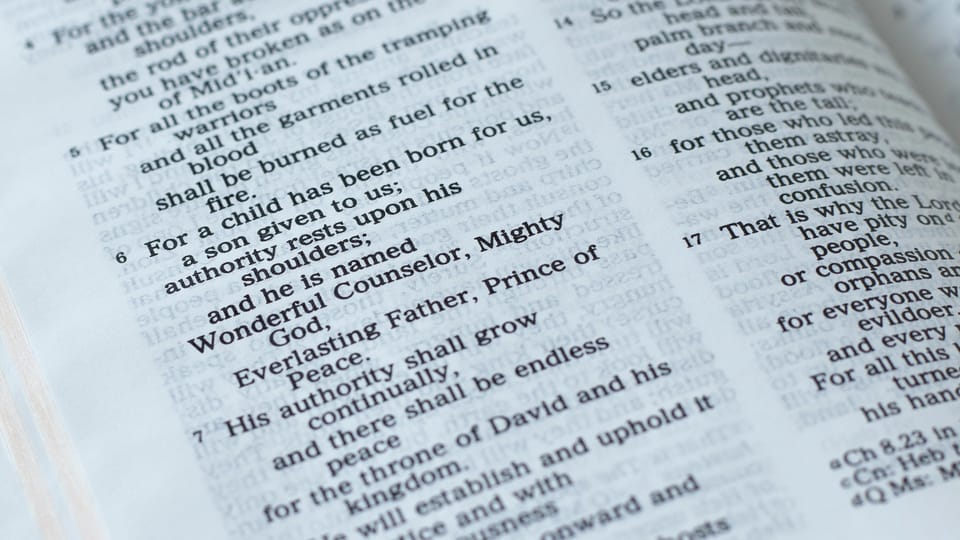
Help comes through a baby who addresses all of our needs (9:6-7)
For to us a child is born,
to us a son is given;
and the government shall be upon his shoulder,
and his name shall be called
Wonderful Counselor, Mighty God,
Everlasting Father, Prince of Peace.
Of the increase of his government and of peace
there will be no end,
on the throne of David and over his kingdom,
to establish it and to uphold it
with justice and with righteousness
from this time forth and forevermore.
The zeal of the LORD of hosts will do this.
This is surprising. God is going to provide help where it’s needed in a way that addresses our biggest problems…how? Through a baby. A child. A vulnerable child. But not just any child. Scholars believe the child's description may refer to King Hezekiah for immediate fulfillment, but it is so vast that it suggests a greater figure. They have to point to Jesus.
The government rests on his shoulders. He can handle all the responsibility. When everyone else crumbles, he has what’s needed.
Isaiah 9 reveals four powerful titles of Jesus:
- Wonderful Counselor – More than a therapist, he is an extraordinary strategist who helps people escape hopeless situations, even those they created themselves. Jesus handles the problems that keep us up at night—finances, health, job insecurity, family struggles. He specializes in situations that look impossible to us. He also addresses our deeper needs: forgiveness, reconciliation with God, and adoption into his Kingdom.
- Mighty God – When facing impossible odds, Jesus is the one to trust. He has all the power necessary for whatever problem you face. He defeats his enemies and proves himself dependable when everything else fails.
- Everlasting Father – In Isaiah’s day, kings were called fathers. Jesus is the ultimate king, except his reign is everlasting. He is the kind of king who cares for his people forever. His reign never ends. He will extend his protective care of his people forever. You can rest in his Kingly care for you.
- Prince of Peace – Jesus reconciles us to God even while we were his enemies. He brings health and wholeness to all who enter his Kingdom.
His “counsel is wise, his power is divine, his love is fatherly, and his rule creates peace” (Ray Ortlund).
Judah was facing an impossible problem. They were facing a problem they couldn’t solve. A storm was coming. Isaiah answers the question: what should they do about it?
And the answer comes back: God responds to our deepest need by sending a royal King to deliver us. He is the One who came to do what we couldn’t do for ourselves. He stands not only as the answer to Judah’s problems but to our problems too. He comes to the darkest places to deal with our deepest issues. His name is Jesus. Turn to him. Trust him. Worship him. This is why Jesus came at Christmas.