What the Law Shows Us (Romans 7:7-13)
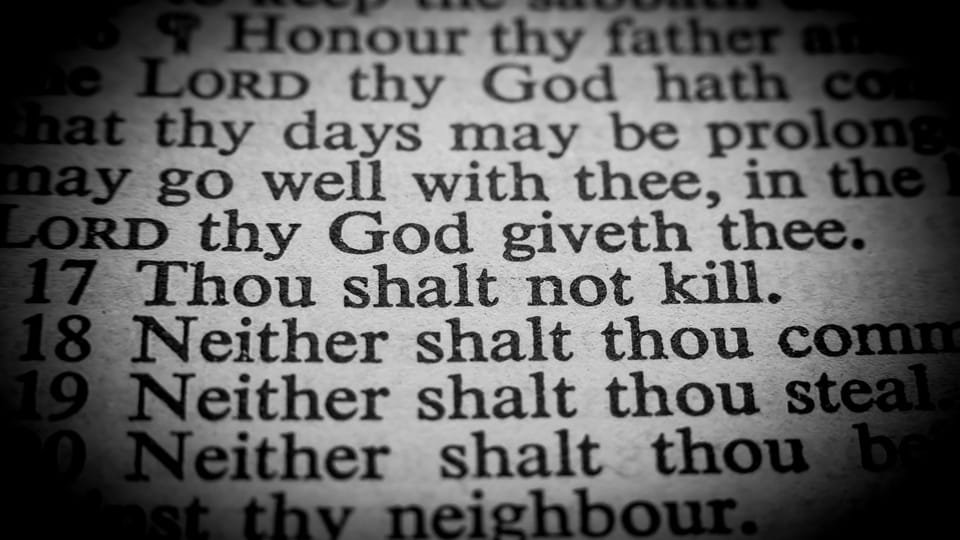
Big Idea: The law is good; it just can't make you good.
Here's an important question: what role does the Old Testament law play in a Christian's life today?
Not everyone agrees, and the disagreements run deep. Here's a brief tour of the major positions, from those who want to keep as much of the law as possible to those who want to leave most of it behind.
- Theonomists believe God's law, including Israel's civil and criminal codes, should still govern nations today. It's a minority view, but a growing one, held with conviction.
- A much larger group divides the law into three categories: moral, ceremonial, and civil. The moral law—the Ten Commandments—remains the Christian's rule of life. The ceremonial law is fulfilled in Christ. Civil laws hold wisdom but aren't directly applicable. This is probably the most widely held evangelical position.
- Others argue the Mosaic Law was one unified package that Christ fulfilled and closed out. We're no longer under Moses but under the teaching of Jesus and the apostles. Most of the Ten Commandments reappear in the New Testament, so they still apply, not because of Sinai.
- Still others draw a sharp line between Israel and the Church: the law belonged to Israel; the Church lives by grace, full stop.
This is more than a theological sparring match. It touches each of our lives. It shapes how we read our Bibles, how we understand the gospel, and how we handle guilt. It quietly drives our moral convictions, our cultural engagement, and our public witness. This debate doesn't just happen in the classroom; it goes with us to work, when we vote, and at dinner.
So how do we understand the law and how it applies to our lives today? That’s what this passage is going to help us understand.
Three Things the Law Shows Us
Last week, in Romans 7:1-6, we saw that Christians have a new relationship to the law. We’re no longer under the law. We were once married to the law. We have become dead to the law. So the relationship has been broken.
Paul’s also taught that the law can’t justify a person, and the law can’t sanctify a person. Not only are we dead to the law, but the law can’t deliver us from sin’s penalty or power. Only Jesus can do this.
You may be thinking that Paul has a pretty negative view of the law. This leads to a question in verse 7: “What then shall we say? That the law is sin?” In other words, what is the value of God’s law? Is the problem with the law itself?
Paul’s answer is clear: “By no means!” Then he goes on to give us three things the law shows us. Here’s the first:
The law shows us our sin (7:7).
What then shall we say? That the law is sin? By no means! Yet if it had not been for the law, I would not have known sin. For I would not have known what it is to covet if the law had not said, “You shall not covet.” (7:7)
Here's the first thing the law does: it reveals the extent of our sin problem.
Most of us walk around thinking we're pretty reasonable, decent people. And there's a reason for that. When we mess up, we have the full story: we were stressed, sleep-deprived, blindsided, or just having a rough week. So we cut ourselves slack. But when someone else messes up, we don't have their backstory. All we see is the behavior, and we fill in the blanks with character. We judge ourselves by our intentions and others by their actions.
That's why most of us genuinely believe we're better than average. We think we're pretty good. And because of that, most people simply don't see themselves as sinners.
This is a dangerous blind spot, and the law breaks it open. It shows us not what we imagine ourselves to be, but what we're actually like. It shows us our true spiritual condition. The law uncovers the depths of our depravity.
What's striking is that Paul reaches for one of the least visible examples: covetousness. Sins like dishonoring parents, killing, or stealing are observable; they involve actions others can see. But covetousness is a disposition, not an action. It lives beneath the surface. The law doesn't just regulate behavior; it diagnoses the heart. Even if you kept every external command perfectly, the heart problem would remain—and the law names it. We want what doesn't belong to us.
And it's a serious problem, because covetousness doesn't stay quiet. It distorts our entire perspective and pulls other sins in behind it. Jesus warned plainly: "Take care, and be on your guard against all covetousness, for one's life does not consist in the abundance of his possessions" (Luke 12:15). Left unchecked, we start measuring life by how much we can get.
Covetousness doesn't just bend our behavior; it corrupts the soul. Puritan Thomas Watson called it "a moral vice which infects and pollutes the whole soul." Desire left unchecked and unconfessed doesn't stay small. It quietly rots everything from the inside out.
You can be an outwardly good person, Paul says, but you’ve still got a problem, and the law shows you what that problem is. Evil thoughts are as sinful as evil deeds. The law shows our polluted thoughts; outwardly blameless, but inwardly a chamber of horrors.
The law shows us our sin. But that’s not the only thing the law shows us:
The law shows us our resistance to God’s authority (7:7-8)
But sin, seizing an opportunity through the commandment, produced in me all kinds of covetousness. For apart from the law, sin lies dead. (7:7-8)
Paul's point is clear: the law stirs our sinful nature to life. The fault doesn't lie with the law; it lies in our hearts. Sin hijacks the law and uses it as a launching pad for more sin.
Before the law arrives, sin may lie quiet. But then the law draws a line, and something in us immediately wants to cross it. We want what we've just been told we can't have. Think of a "Get Off the Lawn" sign to an eight-year-old boy. It doesn't inspire respect for the grass; it makes him want to walk all over it. The law doesn't create the desire; it provokes what was already there.
In Book II of the Confessions, Augustine talks about a small event from his youth: stealing pears from a neighbor's tree with a group of friends. What haunts him about it is precisely its irrationality. The pears were no better than his own. He wasn't hungry. He and his friends threw most of them to the pigs. There was no obvious payoff.
That, Augustine argues, is the most revealing thing about sin. "I loved my own ruin," he wrote. “I only picked them so that I might steal.… I loved nothing in it except the thieving.” Augustine wasn't after pears. He was after the transgression. The desire to steal was awakened by the prohibition against stealing.
Our hearts want to do what they're told not to do. We want sovereignty: to act without constraint or accountability, to grasp what isn't ours.
Nothing has changed. The law says, "Don't covet," and our hearts whisper back, That sounds exciting. Sometimes we sin even when we know it's wrong and there’s no strong reason to do it. That's when sin clearly shows itself as a choice to turn away from God. Not a mistake, but a defection of the heart.
Sin shows us our sin. It also shows us our resistance to God’s authority. And it does one more thing:
The law shows us our desperation (7:9-11)
I was once alive apart from the law, but when the commandment came, sin came alive and I died. The very commandment that promised life proved to be death to me. For sin, seizing an opportunity through the commandment, deceived me and through it killed me. (7:9-11)
This next section is a little layered, so stay with me. It matters.
A quick side note: Paul uses the word "I" throughout this passage. That might seem straightforward, but there's actually a significant debate among scholars about who he's referring to. We'll get into that next week. For now, just hold on to that question.
What Paul is saying here is this: there was a time when he thought he was fine. He believed he had a good standing before God. He was confident in his own moral record.
Then the commandment arrived, and it was a good commandment. Leviticus 18:5 says, "You shall therefore keep my statutes and my rules; if a person does them, he shall live by them: I am the LORD." The law is good. It was designed to lead to life.
But for Paul, the commandment didn't produce life; it exposed death. It woke sin up in his heart. He found himself unable to keep what God required, and his self-confidence collapsed. The law brought him to the end of himself. He had to face what none of us want to face: that before a holy God, he was completely without hope, and he could not save himself.
And yet, that is exactly where we need to be. When we reach the end of ourselves, we finally stop looking inward for rescue. We can't save ourselves. We need a Savior who can do what we cannot.
So, is the law the problem? Paul is direct in verse 12: "The law is holy, and the commandment is holy and righteous and good." The problem is never the law. The problem is us. The law shows us our sin, our resistance to God's authority, and how we can't rely on ourselves. It holds up a mirror. We don't like what we see. But what we see is true.
The law does its work by bringing us to the end of ourselves. And at the end of ourselves, grace begins.
What’s the Problem?
The problem isn’t the law. The problem is us. Verse 13 says:
Did that which is good, then, bring death to me? By no means! It was sin, producing death in me through what is good, in order that sin might be shown to be sin, and through the commandment might become sinful beyond measure.
The problem isn't the law. The problem is what our sin has done with the law. Our sin took what was good (God’s law) and shows us our sin and how utterly sinful we are. The problem isn’t with the law; the law just reveals our problem.
John Piper compares the law to a surgeon's scalpel. A scalpel is designed for healing. But sin snatches that instrument from the surgeon's hand and drives it into us. What was meant to give life becomes the instrument of our death. The problem isn’t with the scalpel; the problem isn’t with the law; the problem is our sin.
The law is good; it just can't make you good. It was never meant to.
Here’s what all of this means for us today.
First, don't devalue God's law. Paul is clear in verse 12: the law is holy, righteous, and good. The law has no defect. We do. We need it because it shows our sins, our refusal to accept God's authority, and our complete inability before a holy God.
Second, use the law. This passage shows us what every sinner needs: to be brought low enough to reach for the gospel. A woman once approached a preacher who was working through Romans. She held up her hand, index finger and thumb barely apart, and said, "You make me feel this small."
The preacher looked at her and replied, "Madam, that's too big. Far too big. Don't you know that much self-righteousness will take you to hell?"
He was right. The law was made to take away all our self-righteousness. It helps us stop trusting in ourselves and trust only in Christ. When you share the gospel, let the law do its job. It shows people that they can't save themselves. Everyone needs a clear understanding of their situation before they will accept help.
Third, and most importantly, run to Jesus. When we finally see our true condition, we see something else: the beauty of what Jesus accomplished at the cross. He didn't come to improve us. He came to save us. He is our only hope, and there is nowhere else to run.