What a Wedding’s Like (Song of Songs 3:6-5:1)
Big Idea: A wedding is a regal, passionate giving of one to another that is blessed by the community.
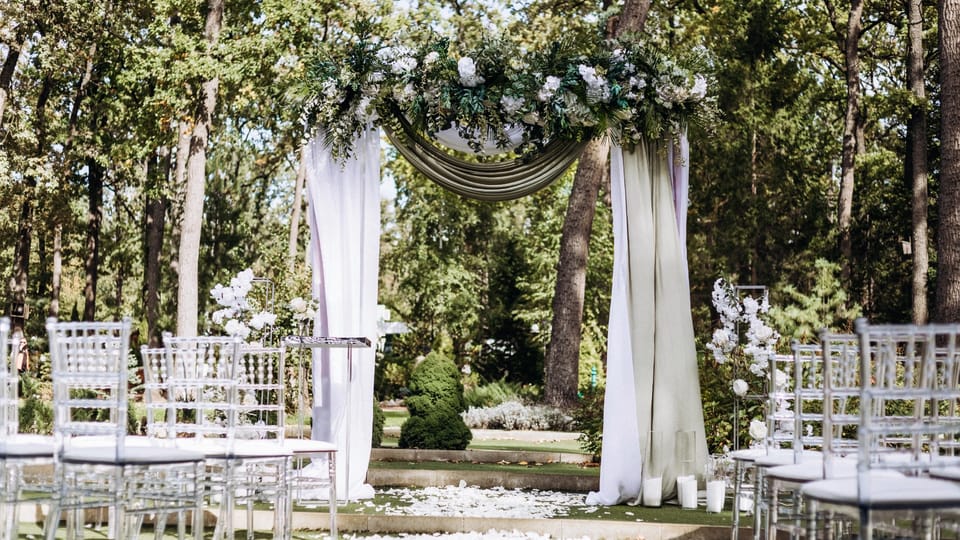
There’s nothing quite like a wedding. Even the most cynical among us can’t help but be moved when a groom stands at the front, waiting, and the bride begins her walk down the aisle. Their expressions and exchanged vows reveal that we’re witnessing something more meaningful than just the moment. And we are! Weddings give us a glimpse of something transcendent, something at the very heart of the universe. Ultimate reality is relational, and God created this universe with marital romance in mind.
We just read a wedding scene that enhances our understanding of marriage and highlights the ultimate marriage that defines all others.
What is a wedding? Three things. Here’s the first.
A Wedding Is Regal
Here’s the question that is asked in 3:6:
What is that coming up from the wilderness
like columns of smoke,
perfumed with myrrh and frankincense,
with all the fragrant powders of a merchant?
A spectacle is approaching. They can see it from a distance. You can sense the anticipation as people look and try to figure out who and what it could be.
Eventually, it becomes clearer what it is in verses 7 to 11. It’s a palanquin or litter, as verse 7 calls it. You may have seen one in pictures. It's made for royalty. It's a carriage without wheels, carried by attendants on poles. It’s beautiful, according to verses 9 and 10. It’s crafted from Lebanese wood with silver posts, a golden canopy, and purple upholstery lovingly embroidered by Jerusalem's daughters. And it’s being carried by 60 mighty men who are armed, experts in war. This is a spectacular scene.
But who is in this palanquin? That is a little tricky to figure out. The simplest answer is that it is Solomon. After all, it’s described as Solomon’s palanquin in verses 7 and 9. And the daughters of Zion are told to go out and look at Solomon in verse 11. There are some hints, though, that it could be the woman arriving.
Here's the main point. The book features a love story between a peasant couple, with the peasant man transformed into Solomon on his wedding day. Eric Ortlund puts it well:
Instead of two rural peasants, the groom sees his bride like an exotic princess, while the bride sees her groom as no less glorious than Solomon himself… Their love elevates what may have been a very humble wedding into a royal one.
The couple's grand wedding celebration resembles Solomon's in its glory.
Isn’t that similar to what happens at a wedding? You’re used to seeing the couple in jeans and t-shirts. But on the wedding day, they’re transformed into royalty. They become nobility.
This tells us something about the nature of marriage. A man and a woman coming together to exchange vows is noble and exhilarating. A wedding is regal. It reveals some of the nobility that God has given us. We should value marriage regardless of our own status because weddings showcase its nobility.
A wedding is regal. Here’s the second thing we see:
A Wedding is Passionate
Chapter 4 to the first part of 5:1 describes the wedding night. This is the apex of the song, and the exact center. “It acts as a kind of fulcrum or centre of gravity about which other counterbalancing scenarios are suspended” (Tom Gledhill). This is intentional. This book is structured with this scene at its center.
For the first time, in verses 8 to 12, he refers to her as his bride. This chapter will showcase a new marital intimacy that they have long desired and are just starting to experience.
In verses 1 to 7, the groom enjoys his bride’s beauty. That’s why he says in verse 1 and then in verse 7:
Behold, you are beautiful, my love,
behold, you are beautiful!…
You are altogether beautiful, my love;
there is no flaw in you.
Some of his descriptions seem a little odd to us. If you take them literally, then she would have looked very unusual indeed. We’re supposed to remember that this is poetry, and that these are metaphors. For instance:
- Her eyes shine with innocence and beauty behind her veil, like gentle doves (4:1).
- Her hair flows thick, dark, and wavy, resembling goats cascading down a mountainside (4:1).
- Her teeth stand perfectly white, evenly matched, and complete—like freshly washed sheep, each with twins, none missing (4:2).
And so on. She looks absolutely perfect to him, and he’s captivated by her beauty. Even though there’s clearly some sizzle happening here, nothing here is dirty. Nothing in what he says is vulgar in any way.
In fact, as Jim Hamilton points out, there’s new creation language here. His language includes imagery of Noah's deliverance (doves), God's blessings of fertile fields and healthy flocks, divine victory at Jericho (scarlet thread), and a new Adam protecting Eden (David's tower). The marriage bed becomes a sacred encounter with God, like returning to Eden through a newly opened path. Listen to what Hamilton says:
If I were to adapt Solomon’s way of speaking to new-covenant realities and use this language to speak to my wife today, I might say something like this:
Your face is a visible expression to me of the blessing of God.
Seeing you I’m reminded that I’m redeemed and given life I don’t deserve.
Nothing matters more to me than Jesus and His Kingdom, and by God’s grace our marriage enacts these most important things in the world.
Gazing on your beauty is like looking out from the pulpit at a church full of people hungry for the Word of God, crying out, ‘Keep preaching!’
Our union is like a trip into the new Jerusalem, where righteousness dwells.
There’s a lot going on here that includes the physical but transcends the physical.
There's more involved than just physical attraction. In verses 9 to 15, there’s an invitation to intimacy. But it begins with her eyes:
You have captivated my heart, my sister, my bride;
you have captivated my heart with one glance of your eyes,
with one jewel of your necklace.
(Song of Songs 4:9)
She’s his bride, but she’s also his sister. “His delight in her is as a whole person, not just a body” (Iain M. Duguid).
In verse 12, he values being the first to share intimacy with her.
A garden locked is my sister, my bride,
a spring locked, a fountain sealed.
Her purity makes her even more beautiful in his eyes. She has kept herself untouched, patiently anticipating their union. Tim and Kathy Keller emphasize that physically giving oneself is essential to fully committing to another person in a lifelong relationship. God designed it that way, so that we give all of ourselves away in the context of marriage.
And then, finally, in verse 16, she invites him into his garden. They finally enjoy what they’ve been looking forward to experiencing for all this time that they’ve loved each other. In the first verse of chapter 5, the man expresses his joy at finally experiencing what they had anticipated.
Feel the sanctity and power of this moment. We talked earlier about not waking up love until it pleases. There’s a power to love and sexuality that has to be carefully protected and guarded because it’s so powerful. But in its place, it’s powerful and holy.
The Bible is not prudish. Again, this is the center of the Song of Songs. It is a holy moment.
At the heart of a Bible book about love is a celebration of marriage and physical intimacy. They are united in heart, soul, and body. Their season of waiting is over, and their union becomes a moment of profound joy. The garden, once sealed and locked, is now open, and it is good. The Song of Songs illustrates that strong human relationships flourish within God's design for marriage, a covenant between a man and a woman.
What is marriage? It’s regal, and it’s passionate. But there’s one more thing we see in this passage:
A Wedding Is Blessed by the Community
Marriage involves more than just a man and a woman; it also includes the celebration of their union by others, as noted in the second part of 5:1. They say:
Eat, friends, drink,
and be drunk with love!
The community joins in affirming their marriage and encouraging them to enjoy its delights. This is such a helpful reminder. Sex and marriage are never merely private matters or individual pursuits for personal gratification. They are gifts designed by God to be enjoyed within the larger framework of the community, reflecting his purposes and glory. When you attend a wedding, you’re not merely a guest or an observer. You’re part of the community that is supporting the legitimacy of what is taking place. You’re not just a spectator; you’re a witness and supporter of what is taking place.
This part of the Song isn’t meant to be an exhaustive treatment of what marriage is like. It’s meant to be enjoyed. But I do find it so helpful in understanding the book’s view of what marriage means. A wedding is a regal, passionate giving of one to another that is blessed by the community.
Here’s what this means for you. If you are in a relationship headed for marriage, this is what you’re aiming for: a regal, passionate giving of yourself to your beloved that is blessed by your community. If you attend a wedding, this is what you’re supporting. You're helping that couple in their regal, passionate giving of themselves to one another as part of the community that is blessing them.
But wait. Weddings can approximate what’s described in this passage, but all weddings and all marriages fall short. We’re all flawed; we’re all sinners. Maybe you’ve already fallen short of the ideas of this passage through your own sin. Or there could be a number of other circumstances that could cause you to despair.
Maybe you’ve been married but it’s fallen apart. Maybe you’re divorced or single or widowed or for some other reason neither married nor to be married. Maybe you’re struggling with homosexuality and don’t think you could ever marry someone of the opposite sex. Marriage was not meant to be an idol. For that reason, I can say with confidence that even if you never marry, even if you never experience this kind of love in marriage, you can still be loved this way if you trust in Christ. What Solomon depicts in Song of Songs 4 will be fulfilled in the consummation of the relationship between Christ and the church. Trust Jesus, and everything Song of Songs 4 points to will be yours when He makes all things new. (Jim Hamilton)
Marriage is a gift, but it's mainly a pointer to a greater marriage that's still to come.
Picture having a reservation at a Michelin-starred restaurant. You know it's going to be extraordinary. On your way out the door, someone offers you a perfectly good granola bar.
Do you reject it? Of course not. You're grateful for it. It satisfies real hunger and gives you energy for the journey. But you don't mistake it for the feast awaiting you. You don't skip your reservation because you had the granola bar. The snack increases your anticipation by reminding you of your hunger and the satisfaction that awaits.
Our marriages work the same way. They offer genuine intimacy, companionship, and love. They meet real needs and reflect God's heart for relationship. But they also leave us wanting more—more understanding, more closeness, more permanence than any human relationship can provide. That longing isn't a flaw in marriage; it's marriage doing exactly what God designed it to do. It's whispering, "This is wonderful, but wait until you see what's coming."
The granola bar doesn't compete with the feast. It prepares you for it. Marriage—even the best marriage—doesn’t compete with the wedding to come that is so much better. It just prepares us for it. And that marriage is coming for all who have turned to Christ.