The Assurance of God’s Love (Romans 5:6-11)
Big Idea: God's love, proven by Christ's death for his enemies, guarantees the complete and eternal salvation of all who are in Jesus.
Romans 5:5 contains one of Scripture's most staggering truths: "God's love has been poured into our hearts through the Holy Spirit who has been given to us."
Paul paints a picture of lavishness. God's love has been, and continues to be, poured out in our hearts until they overflow with divine affection. The Holy Spirit himself serves as the personal agent of this love, dwelling in us to represent God's very heart toward us.
This isn't merely divine pity. It's not even God's kindness. As Spurgeon said, "It is not compassion, nor tenderness, nor pity, but it is love, which is something more than all these." If you are in Christ Jesus, God loves you.
The Lord loves you. He has a complacency and a delight in you. You give him pleasure ; he watches for your good; you are one of his household; your name is written on his heart. He loves you… He that made the heavens and the earth loves me! He whose angels fly as lightning to obey his behests, the tramp of whose marching shakes both heaven and earth, whose smile is heaven, and whose frown is hell, loves me! Infinite, almighty, omniscient, eternal, a mind inconceivable, a spirit that is not to be comprehended; but he, even he has set his love upon the sons of men, and upon me. (Spurgeon)
Most of us struggle to believe anyone would truly love us, especially if they knew our real faults, fears, and hidden sins. This drives us to earn acceptance by projecting a better version of ourselves. But that's not love. True love means complete acceptance and wholehearted service of the other. No wonder we find it nearly impossible to believe God could love us at our worst.
Many of us carry wounds from love that failed. Someone claimed to love us, but their love proved to be a feeling rather than a commitment, and feelings fade.
Paul cuts through all this. God knows you completely, yet he loves you lavishly. This isn't a fluctuating emotion but an eternal commitment; a benevolent disposition that moves him to pour out both physical and spiritual blessings on those made in his image. This is grace. And the highest expression of this love is God's selfless gift of himself to us in Jesus Christ.
This is life-changing if we understand it. There’s nothing like the feeling of being loved. My goal today is to simply work through the six verses we just read and ask four questions that will help us both understand and feel the reality of God’s love for us.
Four Questions
Here are the four questions that help us understand the depth of God’s love for us.
When did God decide to love us?
Verse 6 contains a phrase worth pausing over: "For while we were still weak, at the right time Christ died for the ungodly." What does "at the right time" mean?
Christ's death was no accident or emergency response. It was planned from eternity. Galatians 4:4-5 says, "But when the fullness of time had come, God sent forth his Son, born of woman, born under the law, to redeem those who were under the law, so that we might receive adoption as sons."
God's love for you isn't a recent development. Before you were born, before anyone knew your name, before you committed your first sin, God planned your salvation. This wasn't Plan B. This was his eternal purpose unfolding in history.
God planned this mighty way of salvation before the very foundation of the world, before creation or time. Salvation is not an afterthought; it is part of God's eternal plan. This demonstrates the constancy and eternality of God's love.
How deserving were we?
Did you deserve it? Consider how Paul describes our condition:
- "while we were still weak" (5:6) — We were utterly powerless to save ourselves. Humanity possesses no strength to impress God or contribute anything to its own salvation. We were weak, sickly, unable.
- "ungodly" (5:6) — We were unlike God. Though created in his image to live for and reflect his glory (Genesis 1:26-27), sin defaced that image so thoroughly that we became unrecognizable as his image-bearers. Our intellect, reason, and capacity for communion with God were all marred beyond recognition.
- "while we were still sinners" (5:8) — We were offenders, trespassers, ones who missed the mark. We deliberately flouted God's law, rebelled against him, chose our will over his, and made ourselves guilty.
- "while we were enemies" (5:10) — We harbored deep hostility toward God. Worse still, we stood guilty before him, reprehensible and deserving of his wrath.
How deserving were we?
Christ died for us not because we were lovable, good, or righteous, but because we were sinners. The recipients of God's love weren't lovely or even neutral. They were enemies deserving judgment. Yet God's love reached down to the unlovable, pursuing those who fled from him. This reveals that God's love springs from his character, not from anything attractive in us.
When did God decide to love us? God planned your salvation from eternity, making his love for you not a reaction to your need but the unfolding of his eternal purpose.
How deserving were we? God's love springs from his own character, not from anything in us. He loved us when we were weak, ungodly, sinful enemies who deserved only his wrath.
What did God's love cost him?
How much did it cost the one who loved you? The greater the sacrifice, the deeper the love. An afternoon of time and sweat shows one degree of love. A life given shows another. What, then, did God's love cost him?
Verses 6 and 8 answer plainly: "Christ died for the ungodly... while we were still sinners, Christ died for us." The cost of your salvation was the death of God's sinless Son in your place. As Romans 8:32 says, God “did not spare his own Son but gave him up for us all…” Jesus died the death you should have died so you wouldn't have to. This was no easy, sentimental love. It was costly love, paid at the highest price imaginable.
This is proof of sin’s severity. It shows us the devastating weight of sin. It required the death of God's own Son to redeem us. The infinite price paid by a sinless Savior measures the true extent of our guilt.
Here’s the amazing news: Jesus gave his life for us willingly. God's love for you is entirely unwarranted and unconstrained. It originates in him, flows from him, belongs completely to him. This is the purest and holiest of all loves.
He simply chose to love you. He doesn't love you because you believed in his Son. He loved you while you were his enemy, and therefore he sent his Son.
The cross, with all its shame and ignominy borne by one entirely innocent, stands as the supreme demonstration of God's love. Death is the ultimate act—the final, irreversible gift—and God held nothing back.
- When did God decide to love us? Before time began.
- How deserving were we? Not at all. God loved us when we were weak, ungodly, sinful enemies deserving only wrath.
- What did God's love cost him? Everything: the death of his sinless Son as your substitute.
One more question:
What does God's love secure for us?
Verses 9 to 10 tell us:
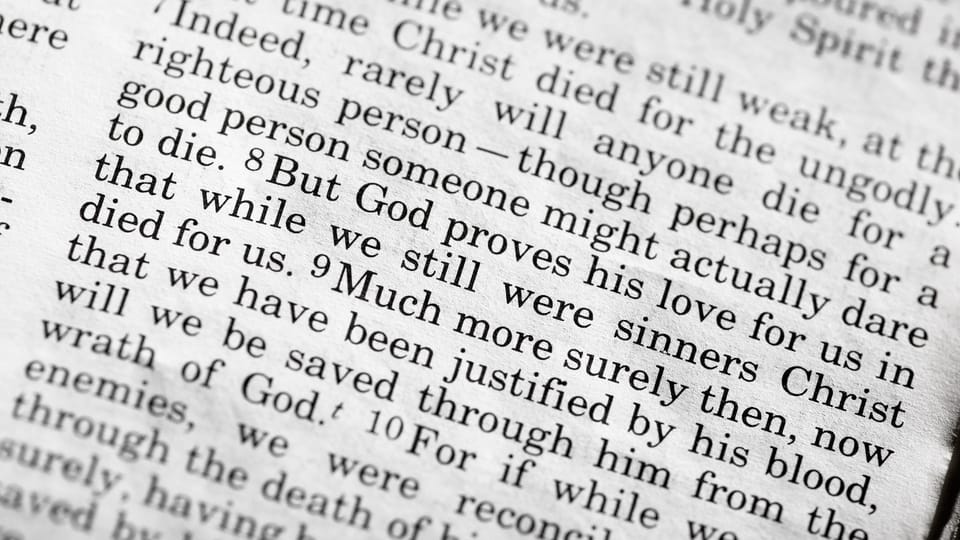
Since, therefore, we have now been justified by his blood, much more shall we be saved by him from the wrath of God. For if while we were enemies we were reconciled to God by the death of his Son, much more, now that we are reconciled, shall we be saved by his life.
God's love shows its magnitude in what it accomplishes: you need not fear final condemnation. You will be saved from God's wrath.
Paul's logic in Romans 5:9 moves from greater to lesser. God justified us through Christ's blood while we were still his enemies, which is the costlier act. He will certainly save us from future wrath, which is the easier. Having sacrificed his Son to reconcile enemies, will he abandon friends? He will not. Much more, he will save them.
Our salvation rests on God's unchanging love, not our grip on him. The reasoning stands firm:
- God loved us as enemies. Will he stop loving us as children? No.
- Christ died for us as sinners. Will he fail to keep us now that we're justified? No.
- We were reconciled through his death. Will we not be preserved by his resurrection life? Yes.
Salvation's security comes from God's character and Christ's finished work. Performance doesn't anchor it. This truth doesn't excuse sin—it fuels grateful worship and obedience.
These verses also show us that salvation has three tenses:
- Past: You are saved from sin's penalty because Jesus paid it all.
- Present: You are being saved from sin's power in this life.
- Future: You will be saved from sin's presence entirely.
Your past, present, and future are secure. Paul's aim is to increase your assurance that God is for you and will be for you through all your tribulations and through the last great outpouring of wrath on the world.
Right now, you can enjoy peace with God, the ability to withstand accusations, standing in God's grace, and rejoicing in the anticipation of God's glory.
The love of Christ that led him to the cross is the same love he has for you now and forever. Because God has already done the hardest thing—justifying you through Christ's blood when you were his enemy—you can be certain he will finish what he started. When doubts come, when life shakes you, when voices tell you you're not good enough, remember: the God who sacrificed his Son for his enemies will not abandon his friends. Your salvation doesn't depend on your performance or your ability to hold on. It depends on Christ's finished work. This means you can face tomorrow without fear, endure today's trials without despair, and rest tonight knowing the love that brought you to the cross will carry you all the way home. God is for you, and he will be for you through everything that comes.
So What?
Verse 11 gives us one natural “so what” from these amazing truths: “More than that, we also rejoice in God through our Lord Jesus Christ, through whom we have now received reconciliation.” The word 'rejoice' (or 'exult') is strong. It means to boast, glory, or delight with great joy. This isn't mild contentment; it's exuberant celebration. And the object of this joy is God himself.
Friends, rejoice. Everything that needed to be done has been done. The pressure’s off. The price has been paid. Your salvation has been accomplished, and you are secure forever. Not only has God saved you, but he loves you. You a delight in God because of all of these truths.
I love what one preacher (John Stott) says:
We should be the most positive people in the world. We cannot mooch round the place with a dropping, hang-dog expression… No, “we exult in God.” Then every part of life becomes suffused with glory. Christian worship becomes a joyful celebration of God and Christian living a joyful service of God. So come, let us exult in God together!
God's love, proven by Christ's death for his enemies, guarantees the complete and eternal salvation of all who are in Jesus. When you understand this truth, it changes everything.
Theologian D.A. Carson writes, “The love of God is not merely to be analyzed, understood, and adopted into holistic categories of integrated theological thought. It is to be received, to be absorbed, to be felt.”
Augustine said something similar: "If you do not wish to die of thirst in this desert, drink love. It is the spring that the Lord wished to put here in order that we may not faint on the way."
Romans 5:6-11 reveals how deep God's love runs. While we were powerless, ungodly, sinful enemies, Christ died for us. This was no reluctant duty but the outpouring of divine love. Through his death we are justified, reconciled, and saved from wrath. Through his life we are kept secure. Through it all, we are brought into joyful fellowship with God himself.
This passage dismantles every fear and doubt. If God did the harder thing—saving enemies—he will certainly do the easier thing: preserving his children. Our salvation is as secure as God's love is unchanging, and that love was proven at the cross.
Let this truth reshape your life, deepen your worship, and fuel your witness. God's love is incomparable, Christ's work is sufficient, and your salvation is secure. Rejoice in God through our Lord Jesus Christ.