Six Months in Isaiah
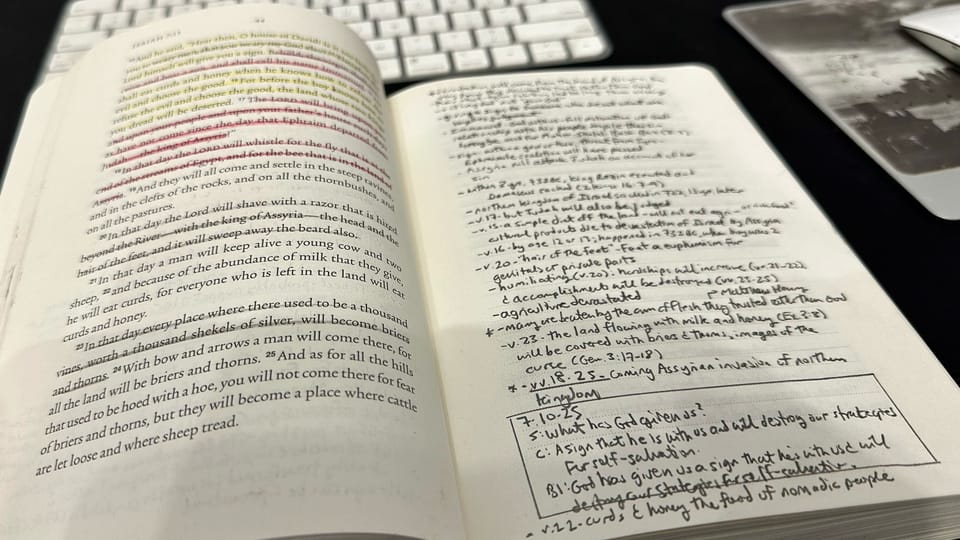
Ray Ortlund once wrote, “Suggestion: Since the Bible is probably too big a book for us to master it all in one lifetime, in addition to many annual read-throughs, choose one OT book and one NT and spend the rest of your life drilling down really deep there. Mine: Isaiah, Romans. Both are addictive.”
“I have never met anyone who knew the Bible too well,” says Ortlund. “It deserves a lifetime of daily attention. Few things deserve that.”
I’ve spent the past six months working through Isaiah for my Big Idea Bible project, and you can see the results here. Ortlund is right: Isaiah is addictive.
It’s hard to overstate its importance in the Bible. It’s the most quoted prophetic book in the New Testament, and its themes reverberate throughout Scripture. It’s also highly applicable today. It was written during a time of shifting geopolitics when it was easy for God’s people to worry and take matters into their own hands. Isaiah’s message: trust God. He’s sovereign over the most powerful nations and the most chaotic world events. Fear and obey him, and you have nothing else to fear.
Isaiah mixes confrontation and comfort. The book stands out for so many reasons. It contains some of the most memorable verses in Scripture, like this one:
Come now, let us reason together, says the LORD:
though your sins are like scarlet,
they shall be as white as snow;
though they are red like crimson,
they shall become like wool.
(Isaiah 1:18)
It also contains some significant prophecies of the coming of the Messiah, like this one:
For to us a child is born,
to us a son is given;
and the government shall be upon his shoulder,
and his name shall be called
Wonderful Counselor, Mighty God,
Everlasting Father, Prince of Peace.
(Isaiah 9:6)
It beautifully describes the work of Jesus:
But he was pierced for our transgressions;
he was crushed for our iniquities;
upon him was the chastisement that brought us peace,
and with his wounds we are healed.
(Isaiah 53:5)
What’s fascinating is not just the verse itself, but where Isaiah places it. The second section of the book (Isaiah 40-66) has three sections (Isaiah 40-48, 49-55, and 56-66). Isaiah 53:5 stands at the very center of the central part of the second part of the book.
In fact, I love the way Isaiah speaks to both his present day in the first part of the book (Isaiah 1-39) and to future generations in the second part of the book (Isaiah 40-66). The second part of Isaiah includes so many highlights:
- God’s comfort to Judah when they felt abandoned by God in Isaiah 40 continues to comfort God’s people today. He is willing and able to deliver his people. His purposes are good, his power unlimited, his strength available to anyone who needs it.
- The famous Servant songs (Isaiah 42:1-9; 49:1-7; 50:4-9; 52:13-53:12) that describe the work of Jesus.
- The invitation for all to join God’s feast free of charge (Isaiah 55) speaks to God’s provision for our deepest needs.
- Isaiah’s portrait of the new heavens and the new earth (Isaiah 65:17-25) is echoed in Revelation and provides hope for every Christian.
There’s so much more. I could spend hours on God’s welcome to the formerly excluded (Isaiah 56:1-8) and his call to tremble at his word (Isaiah 66:2).
I recommend a deep dive into Isaiah for anyone wanting to know God's word better. If you're interested in my Big Idea Bible project, visit my page on Isaiah. I guarantee you that your investment of time in this book will pay off.
I'm grateful for Isaiah and for the message of challenge, comfort, and hope the prophet brings us today. I’ve only scratched the surface of this amazing book.