Levi’s Genes (Matthew 1:1-17)
Big Idea: Matthew's genealogy of Jesus reveals that God is merciful, God judges sin, and God is faithful to keep his promises.
Everyone knows that genealogies are the biggest yawn in the Bible. "Rehoboam begat Abijah, and Abijah begat Ralph" – and so on. It warms the heart about as much as reading the phone book.
It's not often said right out, but it's understood – it's okay to skip over the genealogies. Using our speed-reading techniques, we could read the Bible in about a week if it were just one long genealogy instead of a year. But do you believe 2 Timothy 3:16?
All Scripture is given by inspiration of God, and is profitable for doctrine, for reproof, for correction, for instruction in righteousness. (2 Timothy 3:16)
If this is true, it includes the begats. Join me this morning as I share my first sermon on a topic we've often overlooked—the genealogy of Jesus.
The focus on these names at the start of Matthew shows that what seems boring to us was very important to the original audience. You and I would never dream of starting a book this way:
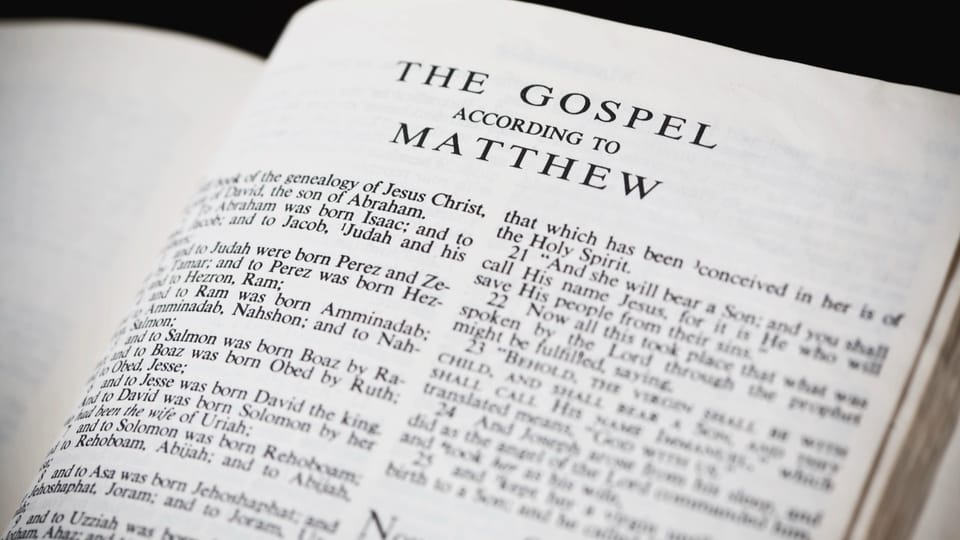
The book of the generation of Jesus Christ, the son of David, the son of Abraham. Abraham was the father of Isaac, Isaac the father of Jacob, Jacob the father of Judah and his brothers… (Matthew 1:1-2)
Genealogies held significant weight in Jesus' era—and they still captivate us today. The Metro Reference Library houses an entire section dedicated to family histories. It’s intriguing to find royal ancestry or connections to pirates, outlaws, or famous explorers in your family history.
In Jesus' world, owning land in Israel required official documentation that verified your genealogy and legitimized your territorial claim. Your ancestral record may unveil your military eligibility or connect you to royal lineage—possibly even to the line of King David. For Jewish people, it traced lineage back to Abraham himself. Certain privileges were exclusively reserved for specific tribes. Priesthood, for instance, demanded Levitical descent—you needed, quite literally, Levi's genes. Yet another crucial factor emerged: God's people understood that the Messiah would come through David's specific family line.
What's remarkable is that throughout the Gospels, even Jesus' fiercest opponents never questioned his Davidic ancestry. His status as heir to David and Abraham—and thus to Israel's covenant promises—was evidently well-established public knowledge.
The genealogy in Matthew 1 is a carefully constructed one. Verse 17 provides an interpretive clue: There are fourteen generations from Abraham to David, fourteen from David to the exile in Babylon, and fourteen from the exile to Christ. (Matthew 1:17) This is a stylized, theological genealogy. There have been names included and other names excluded for a purpose.
Three Lessons
God is, in essence, preaching a three-point sermon to us. Let's dig a little and try to find what's here. Verses 2 to 6 list a great period in Israel's history. It begins with Abraham, the father of Israel, and rises up to David. It covers the Exodus, the conquest of the promised land, and the reign of King David, Israel's greatest king.
Here's the first lesson we learn:
God is merciful.
What is surprising in this section is the mention of four women. Today, the inclusion of women in a genealogy doesn't surprise us. We would almost ask, "Why aren't there more?"
Mentioning women in genealogy was rare and typically done to emphasize the purity and nobility of the lineage. You would expect Matthew to mention some of the grand women of the Old Testament, heroines of the faith. Maybe Sarah and Rebecca and Rachel, the wives of Abraham, Isaac, and Jacob.
But look at the women who are listed: Tamar, Rahab, Ruth, and Bathsheba. Two of these women aren't Jewish at all. Rahab was a Gentile prostitute, and Ruth was a Moabite woman. These were women who did not bring credibility to Jesus' Jewishness; rather, they contaminated his bloodline. But Matthew is teaching us about God's mercy.
There's a wideness in God's mercy, reaching beyond the Jewish people. Matthew teaches that God's love extends beyond the Jewish race, affirming that Jesus is the Savior for all people. This reflects God's promise to Abraham that "Through you shall all the nations of the world be blessed."
You see, God is not sexist. God is not racist. Matthew lets us know that the blood of two Gentile mothers coursed through the blood of the Savior of the world.
But look a bit closer. Tamar tricked her father-in-law into having a child by her by disguising herself as a prostitute. Rahab didn't disguise herself as a prostitute; she was a prostitute!
Bathsheba was summoned by the king while her husband was away at war, leaving her with no power to refuse. Matthew doesn't even mention her name. All we read in verse 6 is simply "And David, the father of Solomon by the wife of Uriah." A thousand years later, and she still isn't David's wife! She is the wife of Uriah. And yet she is a distant grandmother of our Lord.
We seldom talk about Tamar and Rahab in Sunday School, and Bathsheba's story is often misinterpreted; her inclusion highlights vulnerability to power rather than moral failure. Matthew appears to have intentionally included women with complex stories in Jesus' lineage. Why? Because he wants to show us that not only is God's love bigger than the Jewish race, my friend, God's love is bigger than your sin and my sin. God's love embraces us even in our woundedness. God works through the marginalized, the mistreated, and the repentant to bring us the Messiah.
I bet you didn't know that the begats of the Bible drip with the grace and love and forgiveness of Jesus Christ. He's a friend of sinners, a light to the Gentiles. We didn't pick our families, but Jesus picked his. He chose an ordinary human family, where victims and perpetrators, the powerful and the powerless, coexist. If you've never trusted Christ as Savior, you might say, "Pastor, I've got some stuff in my background you don't want in this church." I would hope we'd welcome everyone, just as God welcomed Tamar, Rahab, and Bathsheba into Jesus' lineage. If God loves them, we love them too. And if God commends his love to you while you're still a sinner, as he does, then we love you too. Come to Jesus Christ this morning.
God is merciful. There's another lesson we learn:
God judges sin.
At the beginning of paragraph two, in the middle of verse 6, Israel is riding high, wide, and handsome on the reign of David. They thought they were on the brink of paradise in 1000 BC, when David was at the height of his reign. But suddenly it all crumbled, and everything went downhill. The fourteen generations in verses 6 to 11 take us to Israel's dark period during their exile in Babylon. Israel had entered into a period of great unfaithfulness to God and his commands. As we read the stories of the kings who succeeded David, we find that their hearts weren't fully devoted to the one true God. They worshiped false gods. They engaged in immoral acts. They showed no concern for the poor. Read the prophetic books of the Old Testament, and you'll find that it wasn't a great time in Israel's history.
It is so easy to mistake God's love and mercy for indulgence. God does not take sin and unfaithfulness lightly; God always judges sin. In the messages given to Israel in this period through the prophets, God was yearning for his people to repent. He was longing for his people to return to him, but they continued in their sins.
This morning we've already talked about God's mercy and grace. But we dare not forget that God takes sin seriously. He is waiting for some of you to repent and fully commit to him instead of serving other gods.
You might even be experiencing God's judgment in your life this morning. Listen to Hebrews 12:5-7 and 11:
And have you forgotten the exhortation that addresses you as sons?
“My son, do not regard lightly the discipline of the Lord,
nor be weary when reproved by him.
For the Lord disciplines the one he loves,
and chastises every son whom he receives.”
It is for discipline that you have to endure. God is treating you as sons. For what son is there whom his father does not discipline?...
For the moment all discipline seems painful rather than pleasant, but later it yields the peaceful fruit of righteousness to those who have been trained by it.
God is longing for you to return to him in repentance this morning.
God is merciful, but God judges sin. There's a third lesson that Matthew is teaching us:
God is faithful.
The third set of fourteen ancestors is found in verses 12 to 16, covering the period from the exile to the birth of Christ. The one thing that all forty-two of these people in these three paragraphs had in common was this: they were all waiting. The promise had first come to Abram:
...and through your offspring all nations on earth will be blessed, because you have obeyed me." (Genesis 22:18)
Then it came to David:
I will establish your line forever and make your throne firm through all generations.'" (Psalms 89:4)
And the people waited, generation after generation. Still no Messiah. So they waited some more.
You know how hard it is to wait; we wonder why God isn't acting. Many of us are waiting this morning for God to intervene in our pain and sorrow. We're tired of waiting, and we wonder, "How long, O Lord?" Matthew teaches us about God's mercy, judgment, and faithfulness. When the Holy One came, he was a literal descendant of King David, as God had promised. God did not forget his promises; he remained faithful.
Not only was Jesus the Son of David, he was also the Son of God. Read through the verses, and you read, "So-and-so was the father of so-and-so…" But when you come to verse 16, you come across the startling phrase:
...and Jacob the father of Joseph, the husband of Mary, of whom was born Jesus, who is called Christ. (Matthew 1:16)
He's not Joseph's son; he's Mary's son. He's not Joseph's boy; he's God's Son! The incredible part is, we can enter into this genealogy. Whereas before the bloodline to Abraham was all-important, now what matters is our relation to Christ. Whereas before people would say, "Abraham was our father," now what matters is faith in Jesus Christ.
You don't receive eternal life based on your bloodline. God's genealogy can become your genealogy. By faith in Jesus Christ, you can become God's child:
Yet to all who received him, to those who believed in his name, he gave the right to become children of God–children born not of natural descent, nor of human decision or a husband's will, but born of God. (John 1:12-13)
You might be far from God this morning. But Matthew has an important message for you. God is merciful. It doesn't matter how much you have messed up in your life. God is merciful and loves you. But God judges sin. Don't become complacent with God's mercy. God will judge sin. The Bible tells us:
...for all have sinned and fall short of the glory of God, For the wages of sin is death, but the gift of God is eternal life in Christ Jesus our Lord. (Romans 3:23, 6:23)
God is merceiful, but God judges sin. But there's one more lesson: God is faithful. God has not forgotten you. God has been faithful generation after generation. God is faithful today.
Adapted from a message by Vic Pentz