Acting Our Faith (Luke 10:25-37)
Big Idea: Genuine love for God will inevitably manifest itself through compassionate action toward those who are suffering and in need.
I don't have to remind you that our world is a world of hurt. Every day, 35,000 children die from starvation and malnutrition-related diseases. Additionally, 1.4 billion people live at a subsistence level, lacking basic food, clothing, and shelter. There are 100 million street children under the age of 15 in our large cities around the world, and the heartbreaking statistics go on and on.
Tragically, many followers of Christ are somewhat hardened to the suffering in this world. There are many reasons.
One is distorted theology. Some believe that God only cares about the soul and that helping someone's body is a waste of time. Some believe that the world must get worse before the Lord returns, so they think improving the world delays Jesus Christ's return. Ridiculous, isn't it?
A student told a lecturer, "If we feed hungry people, things won't get worse, and if things don't get worse, Jesus won't come." This view portrays God as a distant absentee landlord, only returning when things get really bad. It's not a positive perspective.
There's another reason why Christ followers are hardened to social justice.
Another reason is an overreaction to the social gospel movement. At some point, Christians may have shifted their focus from the spiritual essence of Scripture to promoting justice in the world. They went too far in their efforts to alleviate global suffering and ignored the soul, along with controversial actions like arming rebels to overthrow oppressive governments. Many churches, such as the one in which I was raised, reacted by condemning almost any sort of social action. Our job, they said, was to save the soul. Let someone else worry about their bodies, their housing, their food.
But maybe the most potent reason is compassion fatigue. Do you ever watch television and see an ad from a humanitarian agency? Sometimes I feel like crying out, "I can't handle more suffering! I can't take another picture of a starving soul!" We're overloaded with images of the suffering that is so present in this world. Christians are compared to those living in a castle who occasionally enter enemy territory for evangelism, but mostly retreat to their fortress, enjoying fellowship without making efforts to improve the world.
My premise this morning is simple: Our love for God will show itself in our social action.
In other words, if you love God, it's going to show in how you treat others who are suffering or in need. No compassion? Then no faith! But if you and I have a genuine love for God and faith, it is going to show in how we treat the poor and oppressed.
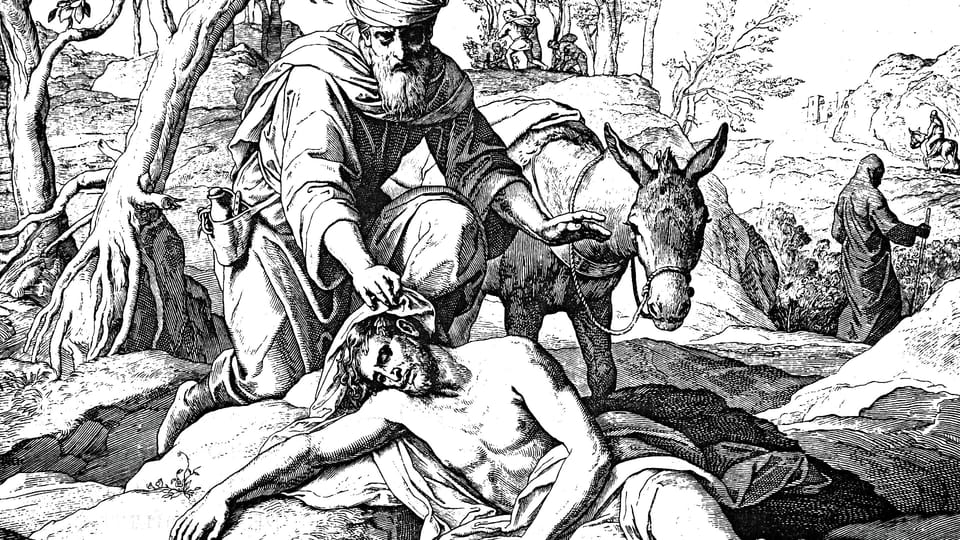
The parable of the Good Samaritan in Luke 10:25-37 drives home a powerful point. Jesus tells the story of a Jewish traveler, robbed, beaten, and left half-dead on a well-traveled road. As dire as the situation is, hope seems to be on the horizon. A religious leader is approaching, followed by a staff member of a local place of worship. Surely, help is on the way, right?
If you could plan the ideal traffic for this situation, you’d think two religious leaders would be perfect. But here’s the twist: the first leader sees the wounded man, veers slightly to the far side of the road, and keeps walking without breaking stride. The second leader does the same—adjusts his path just enough to avoid the man and continues on his way. Both pass by without offering a shred of help. At this point, all bets are off.
Then Jesus introduces an unlikely character: a Samaritan. In the story, this man is a long shot—a typical business traveler headed to an important meeting. To make matters more complicated, he’s from an ethnic group despised by Jews, and the feeling is mutual. Given what the religious leaders did, what are the odds that this Samaritan would stop to help?
The surprising part is that the Samaritan shows compassion. It starts in his heart, moves to his head, and then to his hands. He stops, tends to the man’s wounds, and takes action. Picture him loading the injured man into his car—be it a Lexus or a Taurus—driving him to the emergency room, checking him into a hotel, and paying with his credit card. "Take care of him," he says to the innkeeper. "Whatever it costs, it’s on me. I’ll be back to settle the bill."
Then Jesus turns to his audience and holds him up as an example. He’s the model. Jesus calls us to have compassionate hearts, thoughtful minds that act, and willing hands to help others. No ambiguity here. The call is clear: love your neighbor, even when it’s inconvenient, even when it’s costly. Be like the Samaritan.
Two Observations
Two observations about this passage.
Religious people do not always practice their faith.
I've often wondered how the two religious leaders in Jesus' parable could ignore such a clear need and walk away with cold hearts. How could they notice the suffering and yet keep their hands in their pockets? And then, how could a Samaritan—a long-shot business traveler—be the one to respond with such compassion and action?
It’s a sobering truth: it’s entirely possible to be deeply religious and yet lack even basic human compassion. Some people practice religion as a form of self-righteousness, treating it like a self-improvement plan devoid of grace or love. Others use religion as a tool for power and control, feeding their own sense of importance. Still others are driven by guilt and shame, going through the motions without ever experiencing the transforming love of Christ. Many people engage in religion for various reasons, but often these reasons are not about experiencing true change through Jesus.
In this parable, Jesus reveals a difficult truth: much of what is done in his name, both in the past and today, is not truly related to him. Many religious activities, even today, are disconnected from the tender love and forgiving grace of Christ. Jesus' point is that to genuinely empathize with human suffering, one's heart must first be filled with the love of Jesus Christ. That’s why 1 John 4:19 reminds us, "We love because he first loved us." Our ability to touch the lives of the suffering flows from the way Christ has first touched our sin-scarred lives.
Historically, when believers have been transformed by this love, they’ve made an incredible impact. Christians have founded hospitals, created education systems focused on children's learning instead of labor, and advocated for justice, exemplified by Wilberforce's efforts to abolish slavery. These contributions are well-documented and undeniable.
But we must also acknowledge where Christians have failed. Churches have often supported racism instead of being strong advocates for justice and equality. Even today, 11 o’clock on Sunday mornings remains one of the most segregated hours in North America. While Christians are called to lead the way in social action, too often we fall short.
The challenge is clear: if we are truly moved by the love of Christ, it must show in how we respond to the suffering and needs around us. Compassion isn’t optional; it’s the evidence of a heart transformed by grace.
Religious people do not always practice their faith. But there's another observation I'd like to make:
Caring involves taking action.
Caring isn't a state of mind, it is an action. A homeless woman once approached a country vicar for help. Because he was busy and helpless, he turned her away and offered to pray for her. The homeless woman later wrote this poem:
I was hungry,
and you formed a humanities group to discuss my hunger.
I was imprisoned,
and you crept off quietly to my chapel and prayed for my release.
I was naked, and in your mind you debated the morality of my appearance.
I was sick,
and you knelt and thanked God for your health.
I was homeless,
and you preached to me the spiritual shelter of the love of God.
I was lonely,
and you left me alone to pray for me.
You seem so holy, so close to God
but I am still very hungry – and lonely – and cold.
The apostle James wrote:
What good is it, my brothers, if someone says he has faith but does not have works? Can that faith save him? If a brother or sister is poorly clothed and lacking in daily food, and one of you says to them, “Go in peace, be warmed and filled,” without giving them the things needed for the body, what good is that? So also faith by itself, if it does not have works, is dead. (James 2:14-17)
Last week, a spiritual giant died. His name was Henri Nouwen. He was one of the brilliant theological minds of our generation, a tenured professor at Yale. But listen to what he said at the height of his success. "I felt I needed something else because my spiritual life was not deep. I'm just a fragile person, and I knew that I wasn't rooted deeply enough in Christ. I wanted something more."
A brilliant theologian moved to a small community in Richmond Hill, Ontario, and became a pastor for mentally disabled children. Despite criticism about wasting his life by changing diapers for disabled children, Nouwen felt he was exactly where he belonged. He remained dedicated to this work until he died of a heart attack last weekend at age 65.
"And the King will answer them, 'Truly, I say to you, as you did it to one of the least of these my brothers, you did it to me.'" (Matthew 25:40)
How can you get involved? I challenge you at an individual level – what is there that you can do to serve those in need? Is there anyone who could see themselves visiting those in prisons? What about visiting the elderly in nursing homes, who seldom have any visitors? What about giving some money to a charity? Becoming a volunteer with an organization like TeleCare Etobicoke, or a board member with the Stonegate Community Ministry? What about becoming a Big Brother or a Big Sister? There's lots we can do.
On a bigger scale, what can we do as a church? What can we do to correct more systemic problems in society? You know that we can give charity, but unless we solve the underlying problems, it won't do much good. What can we do to solve the systemic problems?
Since 1948, Mother Teresa has dedicated her life to helping the poorest of the poor in what Rudyard Kipling called "The Big Calcutta Stink." She started her work by saving a woman from the streets who was severely injured and partially eaten by rats and ants. Mother Teresa carried her to a hospital and refused to leave until someone agreed to treat her. She convinced the city to allow her to use a former Hindu temple as a refuge for the destitute and dying.
Over the years, her work expanded exponentially. Tens of thousands have been rescued from the streets. She set up facilities for lepers, orphans, and AIDS victims, sharing her mission of compassion worldwide—from Kenya and Ethiopia to Peru, Mexico, and New York City.
Mother Teresa and her coworkers pray these words daily:
Lord, make me a channel of Your peace,
that where there is hatred, I may bring love,
that where there is wrong, I may bring the spirit of forgiveness,
that where there is discord, I may bring harmony,
that where there is error, I may bring truth,
that where there is doubt, I may bring faith,
that where there is despair, I may bring hope,
that where there are shadows, I may bring light,
that where there is sadness, I may bring joy.
In Jesus’ name. Amen.
The gospel compels us to act because it reminds us of the ultimate act of compassion: Jesus Christ stepping into our brokenness to rescue us. He didn’t pass by on the other side. He didn’t leave us in our sin and suffering. Instead, he came near, took on flesh, and bore our burdens on the cross. His sacrificial love transforms us, filling our hearts with the same compassion he showed us. When we truly grasp the depth of his love, it overflows into how we treat others. We love because he first loved us (1 John 4:19).
Our faith is not meant to be confined to words or rituals, it must be lived out in action. When we care for the least of these, we reflect the heart of Christ and point others to the hope and restoration found in him. Let’s not just talk about love. Let’s show it, embody it, and live it, for the glory of God and the good of our neighbors.