Reasons for Believing in Christ and the Resurrection
Big Idea: Jesus' resurrection, confirmed by history and transformed lives, proves his divinity and offers eternal hope.
There is no question that Jesus Christ existed. Few dispute that he was a historical figure who walked this earth, taught, and died. Modern research and historical studies confirm his life. Historians like Bart Ehrman, a non-Christian scholar, have extensively documented evidence for Jesus, affirming his existence as a well-established fact of history. Archaeological findings support the cultural and geographical aspects of his life, from Nazareth to his crucifixion site. These are not myths but historical realities, acknowledged by both religious and secular scholars alike.
Some of you have been to his birthplace just outside Jerusalem. You can visit the town where he grew up, the river where he was baptized, the mountainside of the Sermon on the Mount, the courtyard of his trial, and the hill of his crucifixion. It's all a matter of the historical record. Non-religious historians reference the life and activities of Jesus.
The real question at stake is whether Jesus is the Son of God. There is ample evidence to support his divinity. Jesus claimed to be Yahweh (John 8:58) and the Messiah (Mark 14:61-64). He claimed equality with God (John 5:18) and authority (Matthew 28:18), accepted worship (Matthew 28:17), and told his followers to pray in his name (John 14:13-14).
His disciples gave him titles of deity (Revelation 1:17), recognized him as the Messiah (Philippians 2:10), prayed to him (Acts 7:59), and referred to him as God (Titus 2:13). The miracles he performed, his fulfillment of Old Testament prophecies, and his sinless life all clearly demonstrate that Jesus is God.
One of the greatest minds of this century, C.S. Lewis, wrote:
I am trying here to prevent anyone saying the really foolish things that people often say about him: "I'm ready to accept Jesus as a great moral teacher, but I don't accept His claim to be God." That is the one thing we must not say. A man who was merely a man and said the sort of thing Jesus said would not be a great moral teacher. He would rather be a lunatic – on a level with the man who says he is a poached egg – or else he would be the Devil of Hell.
Paul Little has pointed out that Jesus could only be one of three things: a liar, a lunatic, or he was telling the truth. The evidence points to the fact that he was telling the truth.
I could spend an entire morning on any one of these points. Entire books have been written. Instead, I'm going to look at the strongest proof that Jesus is indeed the Son of God. And this supreme proof is the fact that He rose from the dead.
It would be difficult for me to overemphasize the importance of the resurrection. I agree with the apostle Paul who said in 1 Corinthians 15:4 that the whole of the Christian faith rests on the resurrection of Jesus Christ. Without resurrection, there is no Christianity. In fact, the Bible says that if Jesus didn't rise from the dead, we're all wasting our time this morning.
Believing in the resurrection is crucial because the Bible states that your eternal destiny depends on your faith in Jesus. In Acts 17:30-31, the apostle Paul says:
The times of ignorance God overlooked, but now he commands all people everywhere to repent, because he has fixed a day on which he will judge the world in righteousness by a man whom he has appointed; and of this he has given assurance to all by raising him from the dead.”
What you believe about Jesus, and especially about the resurrection, will determine your eternal destiny. So let's honestly examine the evidence for the resurrection of Jesus Christ. Throughout history, Christians have believed there is sufficient evidence for rational, unbiased individuals to conclude that Jesus Christ rose from the dead. Cynics hold that the evidence is insufficient. Let's look at the evidence.
Evidence for Jesus' Resurrection
I'm going to use an acrostic that spells "He Arose." If you take the first letter from each point and line it up, it will spell "He Arose." Before you conclude that I'm really clever – don't worry, I stole the idea. Here are seven evidences for the fact that Christ really rose from the dead:
He was dead
You might have heard some say Jesus really didn't die on the cross. Some Muslims are taught that Jesus only appeared to die on the cross. This has come to be known as the swoon theory. It holds that Jesus really fainted on the cross, and when he was taken to the tomb, after a while, the cool air revived him. Sounds like it makes a little bit of sense at first. But let's think about what happened.
John 19:33 tells us that the Roman soldiers did not break Jesus' legs, because they "saw that he was already dead." Later on, when soldiers plunged a spear into Jesus' side, water and blood spilled out. Medical experts testify that if Jesus were not already dead, this in itself would have killed him.
Later on, Joseph of Arimathea asked for Jesus' body so that he could bury it. Before Pontius Pilate released the body, he ordered a centurion to verify that Jesus was dead. An officer in the Roman army would not make a mistake in an important report to a senior official like Pilate. When Joseph and Nicodemus buried the body, they would have noticed any signs of life while wrapping and anointing it.
Medical experts have confirmed that it is impossible for someone to survive or faint during crucifixion and then come down from the cross alive. But you don't have to be a medical doctor to know he didn't come down from that cross alive. Let's suppose he was alive and somehow managed to get off his grave clothes, roll away the tomb, and sneak past the soldiers. What would his appearance have been like? It would have been monstrous, wouldn't have been inspiring, and they would have taken him to a doctor. It wouldn't have inspired the confidence that started the church; that would want a resurrection body like that.
Scholars don't even hold to this theory anymore. There is no doubt this morning that the swoon theory has been discredited. So let's look at a second evidence this morning for the resurrection.
The empty tomb
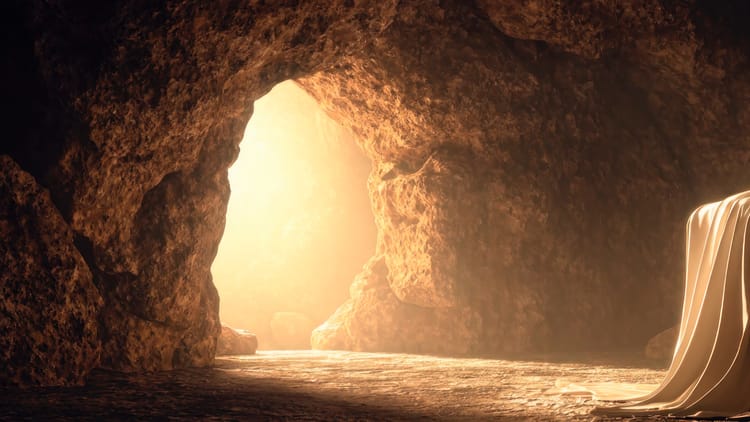
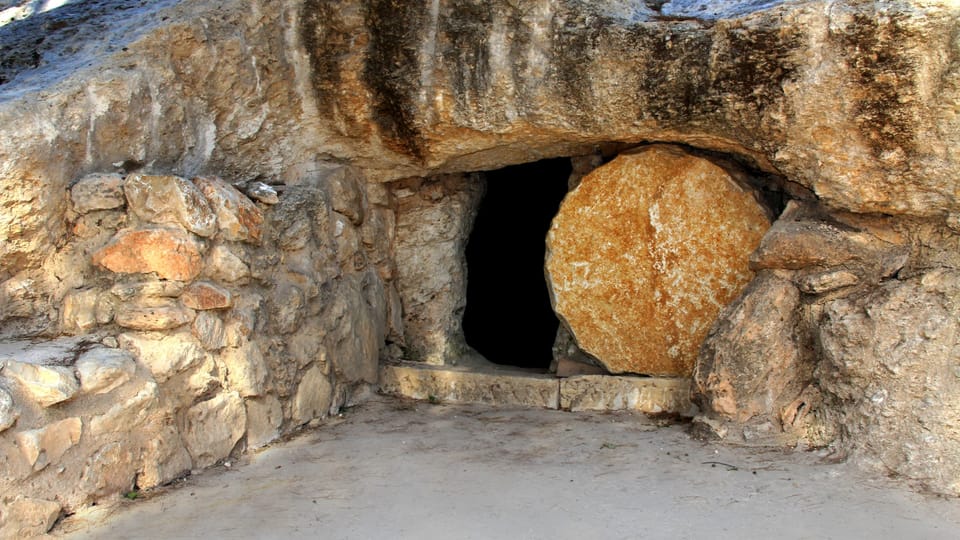
What about the second area of criticism, the empty tomb? On Easter Sunday morning, Jesus' friends found the tomb's stone moved when they visited. How can we account for this?
It is interesting that no serious scholar argues with the fact that the tomb was empty. All of our ancient sources say that the tomb was empty. Both Christian and non-Christian sources, including all four gospels, the book of Acts, and 1 Corinthians 15, confirm that the tomb was empty. From unbelievers, though, we basically have the same report. The empty tomb is not contested by anyone.
Paul Althaus writes, "The resurrection proclamation could not have been maintained in Jerusalem for a single day, for a single hour, if the emptiness of the tomb had not been established as fact." What we do have is a charge that the disciples stole the body. The real issue is not whether the tomb was empty, but why the tomb was empty. What caused the body to be gone? What caused the cave, the tomb, to be empty?
Did everyone go to the wrong tomb by mistake? That could have happened, but then whose grave-clothes did they find? What was an angel doing at someone else's gravesite? And how is it possible that they all forgot their directions at one time? Why didn't the Roman authorities counter their claims by finding the right tomb?
Peter, upon hearing the tomb was empty, hurried inside and found the linen wrappings and face cloth laid out neatly.
Did someone steal the body? Why would the Romans or Jews want to take this body? They sentenced Jesus to death. Why would the Jews want to take the body? They wanted him to stay dead. Some people say that the disciples stole the body. Let's think about that. Why would the disciples steal the body? An even bigger question is, how did they sneak past the guards? Even if the guards were sleeping, how would they ever manage to move the stone and steal the body without waking the guards? Why would the angel who appeared to the women lie about Jesus being risen? And since 515 people saw Jesus in his risen form, how do you account for that if the body was stolen?
So we've established two facts so far that are generally not disputed. One: Jesus died and was buried. Two: Within a short time, his tomb became empty. The question remains: Where was Jesus? That leads us to our next evidence:
The appearances of Jesus
You have to remember that Jesus' disciples did not believe he would rise again. They were discouraged and scattered, and the last thing they ever expected to see was Jesus alive again. And they saw him! First at the tomb. Later on the dusty road to Emmaus. Then in the upper room. For 40 days, Jesus made his appearance throughout the land. In total, he appeared 12 different times to more than 515 people.
Paul writes:
...he appeared to Cephas, then to the twelve. Then he appeared to more than five hundred brothers at one time, most of whom are still alive, though some have fallen asleep. Then he appeared to James, then to all the apostles. Last of all, as to one untimely born, he appeared also to me. (1 Corinthians 15:5-8)
Is it possible that these appearances were hallucinations? The only problem is hallucinations are individual events that happen in our own brain, not shared with other individuals. That would be like me asking you, "How did you like the dream I had last night?" An expert claims that if 500 people experienced the same hallucination simultaneously, it would be a greater miracle than the resurrection. How can people drag out hallucinations over many weeks, in many locations, under various circumstances?
Josephus, the 1st century historian, records, "For Jesus appeared to them the third day alive again, as the holy prophets had predicted." The evidence was clear. Let's pretend we had a courtroom. We were going to call to the stand everyone who saw the resurrected Jesus. We were going to question them, cross-examine them. We're going to spend 15 minutes with each individual. We were going to do it around the clock, day and night. You know how long it would take. We will be here listening to eyewitness accounts all day today, tonight, and throughout the week, including Friday at 8:00 PM.
I wonder how many people, after listening to 128 hours straight of eyewitness testimony, could possibly walk away unconvinced.
We've looked at his death, the empty tomb, and his appearances. Next we have:
The reaction of the officials
A Roman soldier was brave. He was a specially trained, tough-minded, well-equipped warrior. Notice the soldiers' reaction when they felt the earth shake and saw an angel roll back the stone at Jesus' tomb. "And for fear of him the guards trembled and became like dead men" (Matthew 28:4).
The guards were probably afraid of the angels, but also much more. As I already mentioned, keeping watch was an important commission. They knew that various punishments were handed out to soldiers who couldn't stay awake on guard duty. Sometimes they were beaten; other times they were set afire, but most of the time they were just executed. These brave, well-armed men had no way to stop the angel, so they had more than one reason to be afraid.
Do you know what they did? They turned themselves in. In Matthew 28, the officials realized that sending Jesus to his death failed to achieve their goals, so they created a story. They bribed the soldiers to spread the story:
And when they had assembled with the elders and taken counsel, they gave a sufficient sum of money to the soldiers and said, "Tell people, 'His disciples came by night and stole him away while we were asleep.' And if this comes to the governor's ears, we will satisfy him and keep you out of trouble." So they took the money and did as they were directed. And this story has been spread among the Jews to this day. (Matthew 28:12-15)
But think about it. If the disciples had been able to steal the body of Jesus, how would the guards have known it was they who had stolen it if they were asleep? How could a group of men sneak up on trained soldiers, move a stone, unwrap 100 pounds of grave cloths, fold them, lift the body, and carry it away while the soldiers slept? The reaction of the officials proves that Jesus rose again.
Next we have another telling piece of evidence.
The outlook of the disciples
Look at the historical record. At the time of his death, Jesus' disciples were despondent, they were afraid, they fled, they thought it was all over. A short time later, suddenly these same disciples are out, boldly proclaiming that Jesus is alive. Once cowardly men are suddenly going to their death proclaiming that He lives. Almost all of them were put to death for it; 10 of the 11 were put to death for their belief, 6 of them by crucifixion. Yet none disavowed their faith.
Friends, nobody willingly dies for something they know is a lie. If this were a charade, at least one of the disciples would have cracked under pressure and told the truth.
Charles Colson was a counsel to President Nixon and part of the White House staff involved in the Watergate cover-up. Listen to what he says:
I know the resurrection is a fact, and Watergate proved it to me. How? Because 12 men testified they had seen Jesus raised from the dead, then they proclaimed that truth for 40 years, never once denying it. Every one was beaten, tortured, stoned, and put in prison. They would not have endured that if it weren't true. Watergate embroiled 12 of the most powerful men in the world—and they couldn't keep a lie for three weeks. You're telling me 12 apostles could keep a lie for 40 years? Absolutely impossible.
The apostles, who endured decades of persecution and beatings, staked everything on the claim that Jesus rose from the dead. Such unwavering conviction is humanly impossible unless they had truly seen the risen Christ with their own eyes. Only an encounter with the resurrected Christ could have led them to boldly declare, even at the cost of their lives, that Jesus is alive.
Here are two last evidences we'll consider quickly:
The start of the church
On the basis of Jesus' life and teachings, the church began two months after Jesus' death and has continued for over 2,000 years. In Acts 2, Peter delivered a powerful sermon about the risen Christ, resulting in over 3,000 people believing and being baptized that day. Peter remained steadfast in his claim that "The God of our fathers raised Jesus, whom you killed by hanging him on a tree" (Acts 5:30), despite facing opposition from religious leaders.
Peter was not founding a religion based on a creed or philosophy. He was telling people that Jesus Christ is alive. That is the essence of his message, and it is the only thing that can account for the spread of the church over 2,000 years.
And lastly, we have:
The expectation of Christ's return
As you read the New Testament, you have a dramatic sense that the first-century believers were eagerly awaiting Jesus' return. They could not have believed in his second coming without first knowing that he was alive. Otherwise, how would he be able to come back? No one would dare predict Jesus' return if he were lying in a tomb or if his body had been hidden. Their expectation of his return is proof of their belief in the resurrection.
This is it. If you're interested, I have a book documenting a debate between a believer and a skeptic, along with a recording of a mock debate that I can lend you. Here we have Jesus pronounced dead by trained executioners. Completely wrapped in bandages weighing 100 pounds because they were soaked with spices. Placed in a tomb, and a huge rock was rolled in front of it. This rock, according to one source, was so large that 20 men couldn't move it. Then the tomb was guarded by highly disciplined soldiers. Yet death couldn't hold him in the grave.
John Singleton Cauthway, a prominent legal mind and three-time High Chancellor of England, stated that he understands evidence well, and the evidence for the resurrection has yet to be disproven. But where do you stand? You can't stay neutral; there is no middle ground. I can't argue you into believing. But the facts speak for themselves.
I've reached a verdict. The case for Christ is powerful and persuasive. I am convinced to the core that Jesus Christ is the unique Son of God, and I've trusted him with my life. The choice is yours. You're going to have one remaining question: "So what?" What does it mean to you. Come back next week. My message is going to be the impact of these facts on your life.