Mormonism – The Latter Day Saints
Big Idea: Mormonism's gospel contradicts biblical Christianity with its works-based salvation and false prophetic authority, necessitating that Christians recognize these differences when reaching out to Latter Day Saints.
But even if we or an angel from heaven should preach to you a gospel contrary to the one we preached to you, let him be accursed. As we have said before, so now I say again: If anyone is preaching to you a gospel contrary to the one you received, let him be accursed. (Galatians 1:8-9)
Key Facts
- Membership — The global membership totals 9 million, with half residing in the United States. Annual growth includes 250,000–300,000 new baptisms, 75.3% of whom previously identified as Christians.
- Membership Activity — Teenagers must serve two years as missionaries, with over 40,000 currently active in 200 missions worldwide. Each missionary averages six baptisms annually, focusing primarily on house-to-house visitation and evangelizing Christians.
- Literature — Over 3 million copies of the Book of Mormon are distributed each year, along with free periodicals and videos.
- Wealth — The church possesses over $10 billion in business and land assets, making it the second richest institution after the Catholic Church.
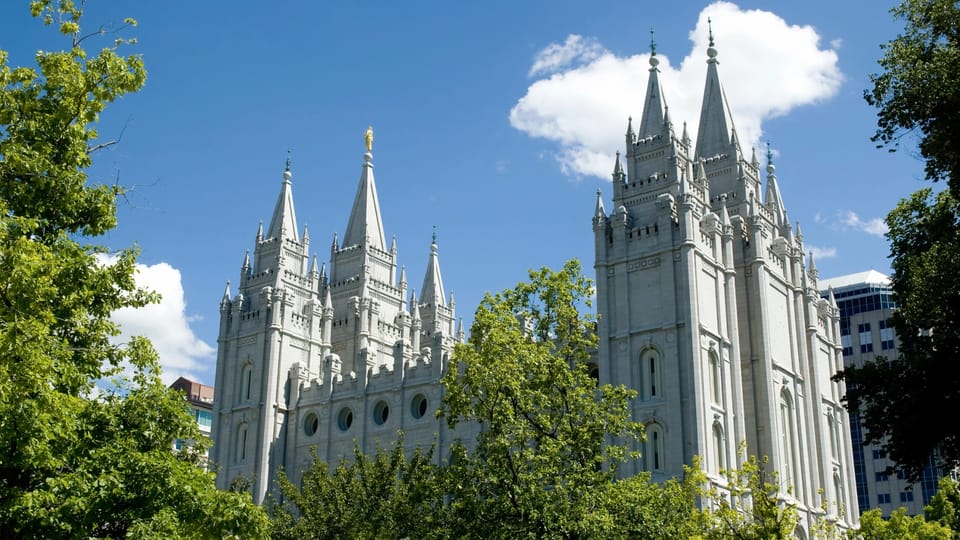
- Mormon Temples — There are 50 temples globally, with an additional dozen in development. Key ceremonies include temple endowments (ensuring entry to heaven), eternal marriages, and proxy baptisms for the dead. Only select members are permitted entry.
- Practices — Members tithe 10% of their income, with local bishops collecting contributions rather than passing an offering plate. Prohibited items include hot drinks, tobacco (except for medicinal use), and alcohol (except for external purposes). Meat is to be consumed sparingly, while coffee and tea are rejected, though hot chocolate is allowed. Large families are encouraged, and "Family Home Evening" on Mondays promotes family bonding through shared activities.
- Structure — Local congregations, called Branches, typically consist of around 200 members. Wards range from 200–800 members. Above these are Stakes (comprising 5–12 Wards), Areas (larger geographical regions), and the central headquarters in Salt Lake City.
- Government — Leadership is headed by the Prophet and two counselors, forming the First Presidency, regarded as living oracles. Below them are the Council of the Twelve Apostles and the First and Second Quorums of the Seventy, each overseeing specific geographic regions.
Mormon History
The Founder — Joseph Smith, Jr., “The Prophet” (1805–1844)
Joseph Smith was born in Sharon, Vermont, and moved with his family to Palmyra, New York, in 1817. His parents, Joseph and Lucy Smith, were inactive Protestants. His father was known for treasure hunting using peep stones and divining rods, a practice Joseph joined. He also reportedly minted his own money.
Smith had a controversial reputation during his lifetime. No reliable contemporary sources endorsed him or his family, who were often described as “destitute of character.” As Mormonism grew, the Smiths faced significant persecution.
In 1820, Smith reported his "First Vision," where God the Father told him that all existing churches were wrong and their creeds were an abomination.
In 1823, three years later, Smith said the angel Moroni appeared to him and revealed golden plates with the "fullness of the gospel" written in "reformed Egyptian hieroglyphics." In 1827, Smith reportedly unearthed the plates along with the Urim and Thummim, special stones said to aid in translation.
In 1829, Smith claimed that John the Baptist appeared to him and conferred the Aaronic priesthood. Later, Peter, James, and John were said to have appeared and conferred the Melchizedek priesthood.
Smith translated the Book of Mormon using a seer stone instead of the Urim and Thummim, dictating it to scribes from behind a curtain. The book was published in March 1830.
Besides the Book of Mormon, Smith created other works, including a "translation" of the King James Bible, which he claimed to have completed through divine inspiration without referring to original Hebrew or Greek texts. He published 135 direct revelations.
The church was officially founded in 1830 in Fayette, New York, and renamed the Church of Jesus Christ of Latter Day Saints in 1834.
Smith’s life ended in 1844 when tensions over Mormon practices, particularly polygamy, reached a breaking point. After ordering the destruction of the anti-Mormon publication The Nauvoo Expositor, Smith and his brother were arrested. While in jail, they were killed by an angry mob.
The Successor — Brigham Young (1801–1877)
Brigham Young succeeded Smith as the leader of the church in August 1844 and is held in equal esteem by Mormons.
In 1846, Young guided the Mormon community, known as "the saints," on a tough journey from Missouri to the Salt Lake Valley in Utah. There, they established a thriving settlement, carving an empire out of the barren landscape. The community’s prosperity grew significantly with the California Gold Rush and the construction of the transcontinental railway.
Young also founded Brigham Young University and governed the Utah Territory until his death in 1877.
Theological Beliefs
Authority
- Mormon Belief: Mormons regard the King James Bible, Book of Mormon, Doctrine and Covenants, Pearl of Great Price, and current prophet's revelations as authoritative.
- Christian Belief: The Bible alone is the inspired, inerrant Word of God and the sole authority for faith and practice.
God
- Mormon Belief: God the Father is an exalted man from another planet. He lived, died, was resurrected, and is married to a goddess wife, who is the mother of all spirit-children.
- Christian Belief: There is one holy, eternal, and perfect Creator God.
Trinity
- Mormon Belief: The Father, Son, and Holy Ghost are three separate gods, each with a distinct body (except the Spirit), united in purpose.
- Christian Belief: God exists as one being in three Persons—Father, Son, and Holy Spirit—each fully God and worthy of worship.
Christ
- Mormon Belief: Jesus is the firstborn of all spirit-children and the brother of Lucifer, Adam, and humanity.
- Christian Belief: Jesus is eternally God, born of a virgin, who died and rose for sinners, ascended to heaven, intercedes for believers, and will return in glory.
Holy Spirit
- Mormon Belief: The Holy Spirit is a divine influence that testifies to Mormon truths, distinct from the Holy Ghost.
- Christian Belief: The Holy Spirit is fully God and fully personal, giving new life, sanctifying believers, comforting, and empowering them for holy living.
Humanity
- Mormon Belief: Humans preexisted as intelligences. Life on earth is a step toward godhood. Adam’s “transgression” is not considered sin, and the ultimate goal is perfection as a god.
- Christian Belief: Humans are created directly by God but fell into sin through personal disobedience, becoming guilty before God and in need of redemption.
Salvation
- Mormon Belief: Christ’s atonement covers Adam’s sin, but salvation requires human works. Practices include baptism for the dead and progression through three heavenly kingdoms.
- Christian Belief: Salvation is a free gift of God’s grace, received through faith in Christ alone, based on his atoning sacrifice.
Church
- Mormon Belief: The early church fell into apostasy, and Mormonism restores the true church with prophets and apostolic authority.
- Christian Belief: Local churches are governed by Christ and comprised of baptized believers, led by pastors and deacons.
End Times
- Mormon Belief: The end times include the gathering of Israel, tribulation, Christ’s return, and a millennial reign. There are three heavenly kingdoms, and hell is not final, as repentance and obedience can lead to heaven.
- Christian Belief: Christ will visibly return, followed by the resurrection and final judgment. The righteous will enjoy eternal joy with the Lord, while the unrighteous will face conscious, eternal punishment.
Tips on Witnessing to Mormons
Mormons view Christian denominations as false, with their primary goal being your conversion. They believe their priesthood grants exclusive authority, and without temple garments, one lacks the authority to teach. They see themselves as "the persecuted church" and expect opposition.
Mormons are encouraged to share their belief by declaring that Joseph Smith was a prophet, the Book of Mormon is true, the Church of Jesus Christ of Latter-day Saints is the only true restored church, and that there is a living prophet today. They often urge others to pray for confirmation, seeking a “burning in the bosom” as evidence of truth.
They reject salvation by grace alone, emphasizing works as part of their belief system. When engaging in dialogue, use the King James Bible, as it holds respect within their tradition. Define terms carefully and use Scripture to examine their claims.
If appropriate, address Mormon history, false prophecies, or obscure doctrines, but avoid letting the conversation center on controversy. Keep the focus on God’s saving grace through Jesus Christ.
Look for signs of openness. Spread the message of the gospel and steer clear of arguments. If you sense no openness, consider ending the discussion prayerfully, trusting God to work in his timing.
Selected Bibliography
Martin, Walter R., The Kingdom of the Cults, 6th Ed., Bethany House, 2019.
Van Gordon, Kurt. Mormonism. Zondervan Guide to Cults & Religious Movements, 1995.